L’etica dell’ invisibile.
ITA:
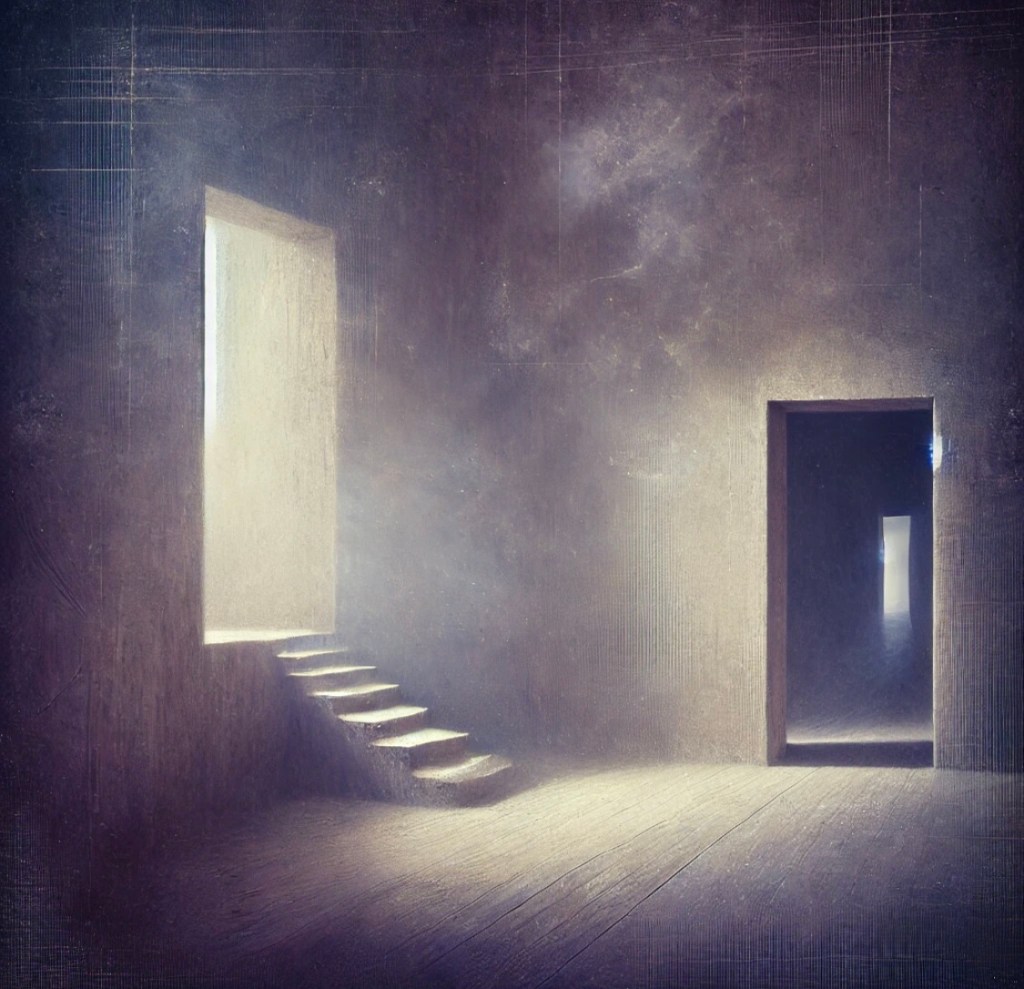
Soglia onirica ispirata a Sciarrino: uno spazio tra suono e silenzio, tra presenza e sparizione.
ENG:
Dreamlike threshold inspired by Sciarrino: a space between sound and silence, presence and disappearance
Ascolto e riflessione sul brano Autoritratto nella notte della morte (1982) di Salvatore Sciarrino, nella storica interpretazione diretta da Claudio Abbado.
Un viaggio tra suono, silenzio, angoscia e misura, dove la musica si fa pensiero sospeso, e l’ascolto diventa un gesto etico.
La notte non è il contrario del giorno, ma la sua profondità.”
Maurice Blanchot
Autoritratto nella notte della morte
Sciarrino / Abbado – Il suono dell’insonnia, del perturbante, del limite.
Reverie spontanea
Respiro. Affanno. Buio. Forse sono finito dentro un brutto sogno.
— Sei sveglio? — È un incubo? — Non mi interessa. Chiudi. Dormi. Svegliati. Ma lasciami.
Passi. Fessure. Inclinazioni. Angoli bui, pareti troppo ripide, fendenti. Grondaie instabili, balaustre semimobili, tetti e lamiere.
Ansietà indiretta. Negoziazione interna. Tremori. Scalpitii. È tutto nella mente? È tutto solo nella notte?
Veglieremo il presente? Rasenteremo la follia…
Passi rapidi. È ancora buio. Urti, balaustre, parallelepipedi… svasatoie… grovigli vitali…
Chiamami. È buio.
Commento
Autoritratto nella notte della morte è uno dei vertici della scrittura sciarriniana. Non si tratta di una narrazione: non appare una trama, né personaggi. Ma c’è un protagonista, il suono stesso, che si destruttura nel momento in cui appare. Claudio Abbado, in una delle sue più sorprendenti e profonde incursioni nel contemporaneo, guida l’orchestra come se stesse trattenendo un respiro, un pensiero che non si può esprimere né esporre, ma nemmeno tacere. La scrittura di Sciarrino, qui, è topografia dell’inquietudine: respiri, rumori interiori, movimenti minimi, come di passi in una dimora isolata dal mondo, e isolata anche al suo interno, in cui perfino i protagonisti sembrano inanimati, eterei. Ma chi suona? Chi ascolta? Forse è solo la memoria del suono, o la sua prefigurazione, prima ancora che nasca.
Sciarrino non scrive musica: descrive il suono che sta per accadere. Il suono come evento liminale, fragile, interrotto. Non c’è mai un canto, ma l’eco di un’assenza, una nota che sussurra appena, che nasce per spegnersi nell’ombra, nella notte. Il suo linguaggio è fatto di sottrazione, ma non è minimalismo: è matericità sonora potenziale. È moto psichico, respirazione emotiva, percezione deformata, accennata. Una scrittura che non vuole rappresentare il mondo, ma mettere l’ascoltatore nel cuore del proprio disorientamento.
Nel buio sonoro di “Autoritratto” si può sentire una psiche che veglia, che cerca, che si sintonizza. Non c’è narrazione: c’è un soggetto che si cerca, si teme, si sfugge. Ogni suono sembra dire: “sono qui”, ma subito dopo la ricerca inquieta riprende, senza sosta. Il suono è transfert, è controtransfert acustico. È un sogno lucido che si disgrega in un tempo perennemente presente, perennemente reale. Come un paziente che balbetta ciò che non può dire, mentre parla dicendo ciò che è costretto a dire. L’analista ascolta le parole come respiri, come esitazioni, omissioni, deviazioni: nel ritmo stesso del significato. Sciarrino è lo psicoanalista del suono.
Allora, forse è proprio questa notte inquieta e minima, questo abitare una dimensione irrequieta del proprio essere, ad averci condotti ad alcune considerazioni. L’angoscia che si muove in questo brano non è il puro negativo, ma un’attenzione sospesa, una forma di sottile vigilanza. Non è la fantasia che ci sottrae alla vita, che ci regala nuovi orizzonti: è l’attenzione percettiva che ci tiene lì, abbarbicati in prossimità dell’esistenza delle cose. Ci tiene dentro.
La musica di Sciarrino non ci invita a evadere: ci chiede di restare in un ascolto che contempli l’ignoranza delle scelte, che permetta di sostare nell’esitazione. E forse è proprio questa esitazione una forma di cura, una possibilità, un transfert positivo. È il sottolineare una soglia, il far emergere. È il realizzare che la libertà, nell’umano, non è l’apertura senza limiti, quella compensatoria, della fantasia, della fuga, delle proiezioni, delle aspettative. Ma forse la possibilità sta nella circoscrizione della realtà. Nella misura. Più ancora: nell’essenzialità.
Ecco: sembra essere questa la notte. Il dubbio. Il buio. Il non poter vedere.
Le cose, al buio, sono più oscure, più lontane, più invisibili. Ma tutto sembra più chiaro, perché nella complessità dello scorgere ci si può accontentare di ciò che è a portata, di ciò che è vicino, di ciò che è essenziale.
Tutto questo sembra essere un margine abitativo. Una rettitudine dello sguardo che perde le speranze di dominare il reale, ma che nel silenzio, nelle vibrazioni, negli scricchiolii, nell’inquietudine, nell’insicurezza e nell’incertezza del buio e dell’oscurità… si ritrova. Si riconosce. Si sfiora.
E forse è proprio questa la morte. La morte della dominazione. La soglia che riconduce la libertà a un’altra forma di esistenza.
“Un pensiero si apre come ferita e si richiude come canto.”
Paul Celan
ENG
Sound Beyond Sound: Sciarrino and the Threshold of the Inner Night.
Ethics of the Invisible
Listening and reflection on Autoritratto nella notte della morte (1982) by Salvatore Sciarrino, in the historic performance conducted by Claudio Abbado. A journey through sound, silence, anxiety and restraint, where music becomes suspended thought and listening becomes an ethical gesture.
The night is not the opposite of day, but its depth.”
— Maurice Blanchot
Spontaneous reverie
Breath. Shortness. Darkness. Maybe I’ve slipped into a bad dream.
— Are you awake? — Is it a nightmare? — I don’t care. Shut down. Sleep. Wake up. But leave me.
Footsteps. Cracks. Inclinations. Dark corners, walls too steep, sharp edges. Unstable gutters, swaying railings, roofs and metal sheets.
Indirect anxiety. Inner negotiation. Tremors. Scraping sounds. Is it all in the mind? Is it all just in the night?
Shall we keep watch over the present? Will we brush against madness…
Quick steps. It’s still dark. Collisions, railings, parallelepipeds… drain troughs… vital tangles…
Call me. It’s dark.
Comment
Self-portrait in the night of death is one of the peaks of Sciarrino’s writing. It’s not a narrative: there’s no plot, no characters. But there is a protagonist — sound itself — which deconstructs the very moment it appears. Claudio Abbado, in one of his most surprising and profound incursions into the contemporary, conducts the orchestra as if holding his breath, a thought that cannot be spoken or shown — yet cannot be silenced. Sciarrino’s writing here is a cartography of unease: breaths, interior noises, minimal movements, like steps in a house isolated from the world — and even from itself — where even the protagonists seem inanimate, ethereal.
But who is playing? Who is listening? Perhaps it is only the memory of sound, or its prefiguration before it even takes form.
Sciarrino doesn’t compose music: he describes the sound that is about to happen. Sound as a liminal, fragile, interrupted event. There’s never a melody, only the echo of an absence, a note that barely whispers, born only to fade into shadow, into night. His language is made of subtraction — but this is not minimalism: it’s potential sonic materiality. Psychic motion, emotional breath, distorted, sketched perception. A writing that doesn’t aim to represent the world, but to place the listener at the heart of their own disorientation.
In the sonic darkness of Self-portrait, one hears a psyche keeping vigil, searching, tuning in. There is no story: there is a subject seeking itself, fearing itself, fleeing itself. Every sound seems to say: “I’m here,” only to dissolve the next moment. Sound is transference. Acoustic countertransference. A lucid dream disintegrating in a time that is forever present, forever real. Like a patient who stammers what cannot be said, while saying what they are forced to say. The analyst listens to words as if they were breaths — hesitations, omissions, deviations — in the rhythm of meaning. Sciarrino is the psychoanalyst of sound.
And perhaps it is this quiet, restless night — this inhabiting of an unsettled inner dimension — that leads us to a few considerations. The anguish that moves through this piece is not pure negativity, but a suspended attention, a subtle form of vigilance. It’s not fantasy that detaches us from life, or opens new horizons. It’s perceptive attention that holds us here, clinging to the presence of things, keeping us within.
Sciarrino’s music does not invite us to escape: it asks us to stay in an act of listening that contains the ignorance of choice, that allows us to linger in hesitation. And maybe hesitation is itself a form of care, a possibility, a positive transference. It underlines a threshold. It lets something emerge. It reveals that human freedom does not lie in endless openness — that compensatory space of fantasy, escape, projections, expectations — but perhaps in the circumscription of reality. In measure. In essentiality.
This is perhaps what night is. Doubt. Darkness. The impossibility of seeing.
Things, in the dark, are more obscure, more distant, more invisible. But everything feels clearer, because in the complexity of perceiving, we may be content with what is close, what is reachable, what is essential.
This may be our inhabited margin. A rectitude of vision that renounces any illusion of dominating reality, but that — in silence, in vibration, in creaks, in unease, in insecurity and the uncertainty of night and shadow — finds itself again. Recognises itself. Brushes against itself.
And perhaps this is death:
The death of domination.
The threshold that brings freedom back into another way of existing.
A thought opens like a wound and closes like a song.”
— Paul Celan
 Reverie Sonore
Lascia un commento