Gadda Bucci Ortolani Salonen in levare
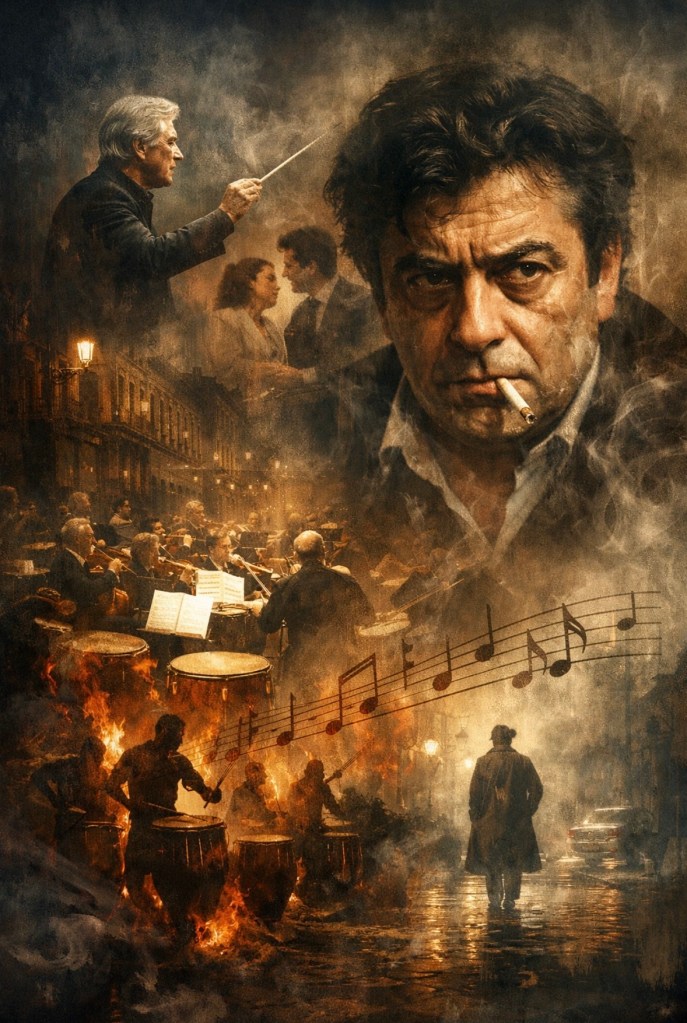
Lo sguardo prima della parola.
The gaze before words.
Bucci non guarda, scruta.
Non recita, non scalpita, non seduce. Porta piuttosto una distanza immediata, qualcosa che d’istinto non torna. Non è l’uomo, non è l’attore, non sono i personaggi. È ciò che emerge, sempre, nel suo abitare istanze scomode, irruenti, in qualche modo feroci, urgenti.
L’uomo sta molto sotto, anche l’uomo del personaggio.
Bucci sembra capace, per sottrazione, di mettere in scena gli istinti, le urgenze, le fissazioni. Di portarli davanti, in primo piano, là dove danno più fastidio, dove non raccontano ma mostrano.
E quando, con quello sguardo un po’ torvo, un po’ più delinquenziale e incerto che rassicurante, pronuncia il suo nome, commissario Ingravallo, comandante della Squadra Mobile, ne Il pasticciaccio brutto de via Merulana, sembra che Carlo Emilio Gadda abbia scritto il suo capolavoro proprio perché venisse esposto a quel cipiglio. Sempre leggermente arruffato, stanco, come sul punto di esplodere, ma attraversato da una tenerezza a fior di pelle, pronta a esondare in pianto da un momento all’altro.
Gadda è la sua lingua.
Una lingua che, contorcendosi in mille sfumature, dialetti, scorribande, è già nevrosi espulsa. Di più, è l’impossibilità stessa della nevrosi di stare dentro la comunicazione, dentro la condivisione. Da qui le torsioni, le deviazioni, le proliferazioni lessicali senza fine.
Così Flavio Bucci, prima ancora di iniziare a parlare, con quello sguardo torvo che sembra spuntare di traverso, con la durezza dei tratti e l’asimmetria dello sguardo, crea una soggezione che prepara, per contrasto, l’estasi delle sue pose febbrili, minute, quando entra in uno stato di grazia e si commuove.
A tenere insieme tutto questo c’è la musica di Riz Ortolani.
Una musica cupa, ripetitiva, quasi ossessiva, leggermente sbilenca. Non accompagna, insiste. Riporta in note quell’atmosfera storta e irrisolta che affiora nei dialoghi più perturbanti, come quelli tra Liliana Balducci e il cugino, quando il desiderio si contorce fino a chiedere un figlio da dare via, gesto insieme estremo e impossibile. Ma quella stessa musica sembra anche ricreare la postura interiore di Bucci, sospesa tra amore e ossessione, tra impulso e trattenimento, fino a lambire ancora una volta la commozione.
Se, per associazione, si volesse spingere oltre questo clima, passando dalla musica che entra in scena a una musica che richiama e riattiva quelle stesse tensioni, ci si potrebbe arrischiare in Esa Pekka Salonen che dirige Silvestre Revueltas, La noche de los mayas, con la Los Angeles Philharmonic.
Non è una musica solo muscolare. È rituale, quasi tellurica. Il ritmo non è festa, ma costrizione. Non celebrazione, ma pulsione che non trova uscita. In quella materia sonora tornano atmosfere cupe e stridenti, ma anche melanconiche, a tratti goliardiche, grottesche, improvvisamente tenere. È la stessa oscillazione che attraversa Bucci, tra ferocia e fragilità, tra durezza e commozione.
La commozione sembrano dirci tutti questi piani insieme è la misura in cui la vita si incunea da sola.
Come quei sospiri più lunghi del normale, sospesi e incomunicabili, in cui ciascuno soppesa l’esistenza intera senza poterne davvero comprendere il peso, né a colpo d’occhio, né attraverso una contemplazione assidua.
Consiglio d’ascolto
Silvestre Revueltas La noche de los mayas, direzione Esa Pekka Salonen, Los Angeles Philharmonic. Ascoltarla non come colore esotico o sfoggio ritmico, ma come corpo sonoro che insiste, trattiene e infine lascia affiorare, quasi controvoglia, una forma di commozione.
The Gaze First
Gadda Bucci Ortolani Salonen in Offbeat
Bucci does not look. He scrutinizes.
He does not act, does not strain, does not seduce. What he brings instead is an immediate distance, something that instinctively feels out of joint. It is not the man, not the actor, not even the characters. It is what always emerges in his inhabiting of uneasy, irruptive, at times ferocious, urgent forces.
The man remains far beneath, even the man of the character.
Bucci seems able, through subtraction, to stage instincts, urgencies, fixations. To bring them forward, into the foreground, where they disturb most, where they do not narrate but expose.
And when, with that gaze at once grim and more delinquent and uncertain than reassuring, he pronounces his name, Commissario Ingravallo, head of the Squadra Mobile, in That Awful Mess on Via Merulana, it feels as though Gadda wrote his masterpiece precisely so it could be embodied by that scowl. Slightly disheveled, worn, as if always on the verge of eruption, yet crossed by a tenderness close to the surface, ready to overflow into tears at any moment.
Gadda is his language.
A language that, twisting itself into countless inflections, dialects, raids of every kind, is already neurosis expelled. More than that, it is the very impossibility of neurosis to remain within communication, within sharing. From this come its endless lexical deviations, its proliferations without rest.
Thus Bucci, even before he begins to speak, with that oblique, jutting gaze, with the hardness of his features and the asymmetry of his eyes, creates a sense of unease that prepares, by contrast, the rapture of his febrile, minute poses, when he enters a state of grace and is moved.
What holds all of this together is the music of Riz Ortolani.
A dark, repetitive, almost obsessive music, slightly askew. It does not accompany. It insists. It translates into sound that crooked, unresolved atmosphere that surfaces in the most disturbing dialogues, such as those between Liliana Balducci and her cousin, when desire contorts itself to the point of asking for a child to be given away, a gesture at once extreme and impossible. And yet that same music seems to recreate Bucci’s inner posture, suspended between love and obsession, between impulse and restraint, brushing once again against emotion.
If, by association, one wished to push this climate further, moving from music that enters the scene to music that recalls and reactivates the same tensions, one might dare to turn to Esa-Pekka Salonen conducting Silvestre Revueltas’s La noche de los mayas with the Los Angeles Philharmonic.
This is not merely muscular music. It is ritual, almost telluric. Rhythm here is not celebration but constraint, not release but a drive that finds no outlet. There is something Stravinskian, filtered through a later, almost post-industrial consciousness, where energy does not liberate but presses and bears down. In this sonic matter return the same dark and strident atmospheres, yet also melancholic ones, at times boisterous, grotesque, suddenly tender. The very oscillation that runs through Bucci, between ferocity and fragility, between hardness and being moved.
Emotion, all these planes seem to tell us together, is the measure by which life forces its way in on its own.
Like those breaths slightly longer than usual, suspended and incommunicable, in which each of us weighs an entire existence without ever truly grasping its burden, neither at a glance nor through sustained contemplation.
Listening recommendation
Silvestre Revueltas, La noche de los mayas, conducted by Esa-Pekka Salonen with the Los Angeles Philharmonic. Listen to it not as exotic color or rhythmic display, but as a sonic body that insists, restrains, and finally allows, almost unwillingly, a form of emotion to surface.



Rispondi