ITA-ENGLISH BELOW
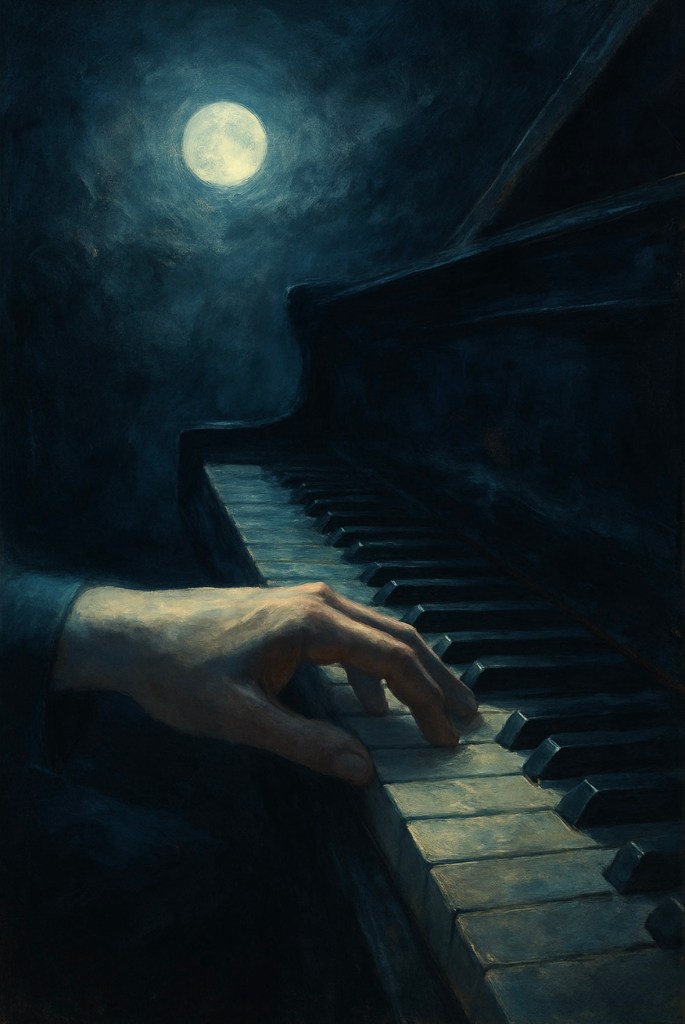
La mano sinistra accarezza il silenzio, sotto la luna. The left hand caresses silence beneath the moon.
La poesia in musica è difficile da nominare.
Ognuno custodisce il proprio esempio segreto:
Michelangeli nel Concerto in sol maggiore,
Rachmaninov tra riflessi d’oro e malinconia.
Ma qui siamo altrove.
Non si tratta di incanto intimista o armonie sospese.
Qui si va oltre.
È come costruire un mondo con la sabbia e un filo d’acqua,
e vedere che prende vita.
Questa è la magia di Ravel:
non restituire la vita,
ma inventarne una nuova forma.
La sua musica non consola: chiama a esistere.
E lo fa con una mano sola.
La mano sinistra non è residuo, né compensazione.
È un punto di necessità interna,
il luogo in cui la forma è costretta a emergere.
Non ciò che resta, ma ciò che inizia.
Federico Leoni, nell’incipit de L’automa,
evoca un poeta ferito in guerra, privato di una gamba.
Ma non è la storia di una perdita che modifica un soggetto già dato.
Non c’è un’identità che precede il trauma,
né un trauma che la sovrascrive.
C’è piuttosto una logica intrinseca alla complessità del soggetto stesso,
in cui l’evento non è rottura esterna,
ma manifestazione strutturale.
La frattura non interrompe:
è una delle forme attraverso cui la composizione si dà.
È decomposizione e articolazione,
un varco che rivela la tensione costitutiva del reale.
La composizione, allora, non viene dopo.
Non è reazione.
Avviene attraverso la frattura.
Meglio ancora: è frattura che prende forma,
forma che non coincide con l’unità,
ma con la necessità di articolare ciò che non è riducibile.
Non c’è canto nostalgico di ciò che fu,
né celebrazione della resistenza.
C’è il suono di qualcosa che non può non darsi,
perché la tensione che lo genera
è più forte di ogni interezza.
E in quel gesto, obliquo, asimmetrico, essenziale,
la soglia diventa forma,
e la forma diventa possibilità dell’essere.
In fondo, ciò che accade in questo concerto,
come nella mente che pensa davvero,
è ciò che Bion avrebbe chiamato trasformazione in O:
un punto in cui la forma si fa esperienza,
e l’esperienza si fa irriducibile,
perché non può più essere evitata né mascherata.
Non c’è ritorno.
Non c’è compimento.
Solo il silenzio da cui emerge
il primo suono necessario.
E quella mano — sola, ostinata, sufficiente,
che continua a suonare
come se il senso dovesse ancora essere inventato.
Consiglio d’ascolto / Listening Suggestion
Per accompagnare la lettura e approfondire l’esperienza musicale, ti invito ad ascoltare l’interpretazione di Pierre-Laurent Aimard del Concerto per la mano sinistra di Ravel, diretta da Pierre Boulez. Questa esecuzione cattura l’essenza del brano con una chiarezza e una sensibilità straordinarie.
Guarda su YouTube / Watch on YouTube
🎧 Ascolta su Spotify / Listen on Spotify
ENGLISH
The Left Hand of the Dream – Ravel, the Magician
Poetry in music is hard to name.
Everyone holds a secret example:
Michelangeli in the Concerto in G major,
Rachmaninov in golden reflections and melancholy.
But this is something else.
It’s not about intimate enchantment or suspended harmonies.
This goes further.
It’s like building a world with sand and a thread of water —
and watching it come alive.
This is Ravel’s magic:
not restoring life,
but inventing a new form of it.
His music does not console: it summons you to exist.
And it does so with one hand alone.
The left hand is not a remnant, nor compensation.
It is a point of inner necessity,
a place where form is forced to emerge.
Not what remains, but what begins.
Federico Leoni, in the opening of L’automa,
evokes a poet wounded in war, missing a leg.
But this is not the story of a loss that modifies a pre-existing subject.
There is no identity that precedes the trauma,
nor a trauma that overwrites it.
Rather, there is a logic intrinsic to the subject’s complexity,
in which the event is not an external break,
but a structural manifestation.
The fracture does not interrupt:
it is one of the forms through which composition gives itself.
It is decomposition and articulation,
a breach that reveals the constitutive tension of reality.
Composition, then, does not come after.
It is not a reaction.
It happens through the fracture.
Better yet: it is the fracture taking form,
a form that does not coincide with unity,
but with the need to articulate what cannot be reduced.
There is no nostalgic song of what once was,
nor celebration of resistance.
There is the sound of something that cannot help but emerge,
because the tension that generates it
is stronger than any wholeness.
And in that gesture — oblique, asymmetrical, essential —
the threshold becomes form,
and the form becomes the possibility of being.
In the end, what happens in this concerto —
as in a mind that truly thinks —
is what Bion would have called a transformation in O:
a point where form becomes experience,
and experience becomes irreducible,
because it can no longer be avoided or masked.
There is no return.
No completion.
Only the silence from which emerges
the first necessary sound.
And that hand — alone, insistent, sufficient —
keeps playing
as if meaning had yet to be invented.
Listening Suggestion
To complement your reading and deepen the musical experience, I invite you to listen to Pierre-Laurent Aimard’s performance of Ravel’s Concerto for the Left Hand, conducted by Pierre Boulez. This rendition captures the essence of the piece with remarkable clarity and sensitivity.*
 Reverie Sonore
Lascia un commento