
ITA:
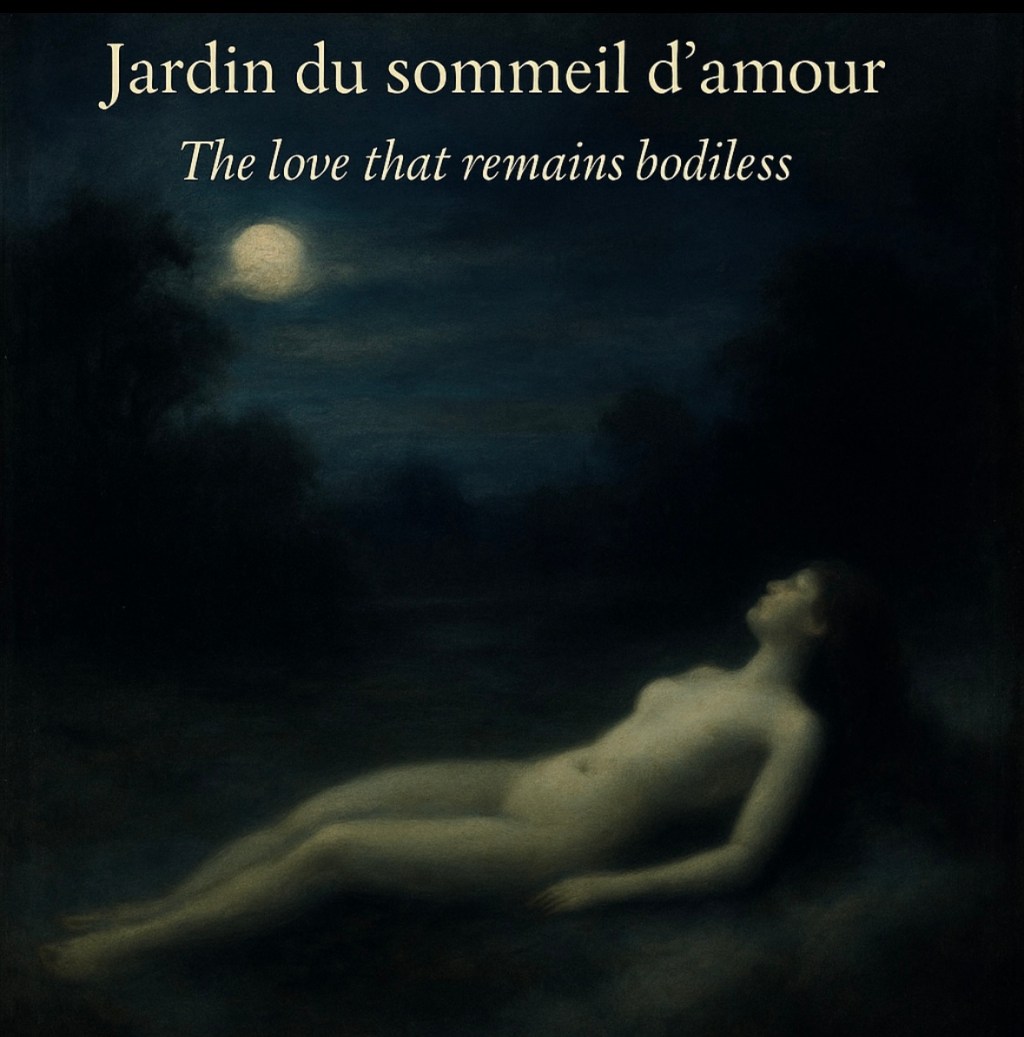
Sospensione notturna tra corpo e sogno. L’amore che resta, senza materia.
EN:
Nocturnal suspension between body and dream. The love that remains, without substance.
L’amore che resta senza corpo
In Jardin du sommeil d’amour, il sesto movimento della Turangalîla-Symphonie di Olivier Messiaen, non c’è fusione, né climax, né tragedia. Solo una sospensione: un atto devoto alla presenza attraverso l’assenza, un giardino che non è spazio ma tempo emotivo disteso, un sogno musicale in cui il corpo non appare, ma pervade.
Tre interpretazioni, quella rarefatta e ipnotica di Kent Nagano, quella febbrile e dolente di Seiji Ozawa, e quella intima e sospesa di Juanjo Mena con Steven Osborne, rivelano le tre anime di questo giardino notturno:
– lo spirituale che si sfibra nel ricordo,
– il carnale che insiste nel vuoto,
– l’amore che si fa presenza senza materia.
1. Kent Nagano – Il giardino rarefatto
Reverie
Non è solo ricordo d’infanzia,
e le notti non sono limpide.
C’è un velo, una lacrima spettrale, spiritica più che spirituale.
È uno sguardo di donna, ma obliquo.
È una notte non senza venti, ma senza veli.
La cute nuda brilla alla luce lunare,
ci si accarezza senza toccarsi,
si danza senza doversi muovere,
si immagina senza voler volare via.
Si ama senza doversi concedere.
È la magia di essere senza il dono dei vincoli,
senza una maternità alle spalle,
senza materia a sostenere l’essere,
senza desiderio a richiamare l’orgasmo.
È un impeto ipnotico senza trance;
un rituale magico per scomparire rimanendo immobili dove si è.
2. Seiji Ozawa – Il sogno contaminato dal corpo
Ma nell’ascolto di Ozawa, quel giardino si scalda.
La nostalgia si incarna. Il tempo si fa memoria colpevole.
L’amore non è solo evocazione spirituale: è assenza incarnata, vuoto che ha avuto forma. E il sogno si contamina col corpo:
Movimenti più familiari, ampi, nostalgici.
Il corpo esibito per essere visto anche senza luce, anche senza volontà.
Dormire e fermarsi, o cercarti ancora?
Ripeto ancora il tuo nome,
ma forse solo per richiamare l’immagine del tuo corpo.
Non mi è rimasto proprio nulla di te,
come non fossi esistita, come non fossi persona,
come non fosse amore.
Solo il corpo manca a questo appello in negativo…
e se fosse quello il solo vero… amore?
3. Juanjo Mena & Steven Osborne – La sospensione nuda
E infine, con Osborne e Mena, giungiamo al giardino più discreto e profondo.
Qui non c’è né slancio, né rimpianto:
c’è un mare sonoro che sospira sottopelle,
una nenia ipnagogica che sfuma l’Io.
La musica è nuda,
e ciò che resta è il battito minimo della coscienza sensibile,
come se l’amore non avesse più bisogno di soggetto.
Arriva una brezza,
è il mare… il vuoto?
Corpi nudi nuotano nello spazio, come unica forma d’amore.
È dunque un’ossessione?
Una nenia quieta e dolente,
un sorriso triste,
il sapore della solitudine?
Amore mio, eri stata sempre tu
o ti creavo io accanto a me?
Cosa esiste davvero in questo sogno che sembra un incubo?
È l’esistere a sussurrare nenie,
o è tutto solo dentro di me?
Può la logica essere ontologica?
Accarezzami ancora.
Perdi ogni strato.
Abbandona ogni habitus
in questa macabra danza.
L’amore che non domanda
In questa rêverie tripla si manifesta ciò che Winnicott chiamava l’essere senza bisogno di fare, una fase dello sviluppo in cui il bambino può semplicemente “essere” in presenza della madre, senza dover compiacere, agire o produrre senso.
Un amore che non domanda, ma permette di esistere nell’ombra dell’altro, in uno stato di fiducia pre-simbolica.
Il giardino di Messiaen è allora uno spazio potenziale, un’area intermedia in cui il desiderio non cerca oggetto, ma forma.
È il regno di ciò che non si realizza, ma trasmette senso attraverso la mancanza.
Bion, Green, Ferro: contenere l’assenza
Bion ci offre la chiave per ascoltare questa musica come una forma di reverie trasformativa: la capacità di contenere l’elemento grezzo, il dolore informe, e trasformarlo in esperienza emotiva pensabile.
La musica, così, non interpreta né consola, ma contiene.
È una funzione α sonora, che consente al trauma dell’assenza di non lacerare, ma abitare.
André Green ci ricorda che l’assenza non è solo una lacuna, ma una presenza negativa: una forza che struttura lo psichico nella forma del vuoto.
Nel giardino messiaeniano, il corpo mancante non svanisce, ma plasma il campo del desiderio.
Con Ferro e Civitarese, la rêverie diventa narrazione emotiva condivisa: una storia senza parola, un affetto che prende forma tra analista e paziente, tra ascoltatore e musica.
Nel giardino, allora, non ci sono soggetti isolati, ma una soglia intersoggettiva, in cui la musica è il campo stesso dell’incontro, il luogo in cui l’amore non accade, ma si abita.
Lacan, Žižek: l’amore come mancanza strutturante
Ma un’altra voce si affaccia in controluce: quella di Lacan, e con lui Žižek.
Per loro, la mancanza non è da colmare, ma da mantenere come fondamento.
Non è trauma da pensare, ma reale che struttura il desiderio.
Il corpo mancante, allora, non è da colmare, è ciò che costituisce il legame stesso.
Nel giardino, non si ama nonostante l’assenza, ma attraverso di essa.
Non c’è bisogno di compimento, perché il desiderio nasce dal vuoto.
L’amore che resta
Là dove non c’è il corpo, ma la sua assenza vibrante,
nasce una nuova forma di amore:
– l’amore come possibilità di esistere nell’altro senza esigerlo,
– come impronta che resta senza più materia,
– come contatto che non tocca, ma trasmette.
La musica qui non serve a esprimere un sentimento,
ma a trattenerlo nel tempo.
Non chiede conferma, si consegna.
E forse proprio questo è l’amore che resta:
quello che non si compie,
ma che trasforma chi lo ha sognato.
Messiaen – Turangalîla: Jardin du sommeil d’amour
The love that remains bodiless
In Jardin du sommeil d’amour, the sixth movement of Olivier Messiaen’s Turangalîla-Symphonie, there is no fusion, no climax, no tragedy.
Only suspension: a devotional act of presence through absence.
A garden that is not space, but emotional time stretched out,?a musical dream where the body does not appear, yet pervades.
Three interpretations, Kent Nagano’s rarefied and hypnotic version, Seiji Ozawa’s febrile and grieving one, and Juanjo Mena with Steven Osborne’s intimate and suspended reading, reveal the three nocturnal souls of this garden:
– the spiritual, unraveling in memory,
– the carnal, persisting in the void,
– love becoming presence without substance.
1. Kent Nagano – The rarefied garden
Reverie
This is not just childhood memory,
and the nights are not clear.
There’s a veil, a ghostly tear,?more spiritistic than spiritual.
It’s a woman’s gaze, but slanted.
It’s a night not without winds, but without veils.
Bare skin gleams in moonlight,
we caress without touching,
we dance without needing to move,
we imagine without wanting to fly away.
We love without having to surrender.
It’s the magic of being without the gift of binds,
without a maternity behind us,
without matter to uphold being,
without desire to summon orgasm.
It is a hypnotic impulse without trance;
a magical ritual to vanish while remaining motionless.
2. Seiji Ozawa – The dream contaminated by the body
But in Ozawa’s reading, that garden warms.
Nostalgia becomes incarnate. Time turns into guilty memory.
Love is no longer just spiritual evocation: it is embodied absence, a void that once had form. And the dream is contaminated by the body:
Familiar, wide, nostalgic movements.
The body exposed to be seen even without light, even without will.
To sleep and stop, or to seek you again?
I repeat your name again,
perhaps just to conjure your body’s image.
Nothing of you remains in me,
as if you had never existed, never been a person,
as if it had never been love.
Only the body is absent from this negative calling…
and what if that is the only true… love?
3. Juanjo Mena & Steven Osborne – Naked suspension
Finally, with Osborne and Mena, we arrive at the most discreet and profound garden.
Here there is neither longing nor regret:
only a sonic sea that sighs beneath the skin,
a hypnagogic lullaby that dissolves the self.
The music is bare,
and what remains is the minimum heartbeat of sensitive awareness,
as though love no longer needed a subject.
A breeze arises.
Is it the sea… or the void?
Naked bodies swimming through space, the only form of love.
Is it an obsession?
A quiet, sorrowful chant,
a sad smile,
the taste of solitude?
My love, had it always been you—
or did I create you beside me?
What truly exists in this dream that feels like a nightmare?
Is it being itself that hums lullabies,
or is it all within me?
Can logic be ontological?
Touch me again.
Shed every layer.
Abandon every habitus
in this macabre dance.
Love that doesn’t demand
In this triple rêverie emerges what Winnicott called being without needing to do, a developmental phase where the child can simply be in the mother’s presence, without pleasing, acting, or producing meaning.
A form of love that does not ask, but allows one to exist in the other’s shadow, in a state of pre-symbolic trust.
Messiaen’s garden thus becomes a potential space, an intermediate zone where desire seeks not an object, but a form.
It is the realm of what does not come to pass, yet conveys meaning through absence.
Bion, Green, Ferro: containing absence
Bion offers us the key to hearing this music as a form of transformative rêverie, the capacity to contain raw elements, formless pain, and transform them into thinkable emotional experience.
Music, in this way, does not interpret nor soothe, but contains.
It becomes a sonic α function, allowing the trauma of absence not to tear apart, but to dwell.
André Green, in turn, reminds us that absence is not merely a void, but a negative presence: a force that shapes psychic structure through its very emptiness.
In Messiaen’s garden, the missing body does not vanish, but sculpts the field of desire.
With Ferro and Civitarese, rêverie becomes shared emotional narrative: a wordless story, an affect taking shape between analyst and patient, between listener and music.
In this garden, there are no isolated subjects, but an intersubjective threshold, where music itself is the very field of encounter,
the space where love does not happen, but is inhabited.
Lacan, Žižek: love as structuring absence
Yet another voice appears in backlight: that of Lacan, and with him Žižek.
For them, absence is not to be transformed, but to be preserved as foundation.
It is not a trauma to process, but a Real that structures desire itself.
The missing body is not to be filled in,
it is what constitutes the very form of the bond.
In the garden, love happens not in spite of absence, but through it.
No fulfillment is needed, because desire is born from the void.
The love that remains
Where the body is not, but its vibrating absence is,
a new form of love is born:
– love as the possibility of existing in the other without possessing them,
– as a trace that remains without substance,
– as contact that does not touch, but transmits.
Here, music does not express a feeling,
but holds it in time.
It does not seek affirmation,
it yields itself.
And perhaps this is the love that remains:
the one that never fulfills itself,
but transforms the one who dreamed it.
 Reverie Sonore
Lascia un commento