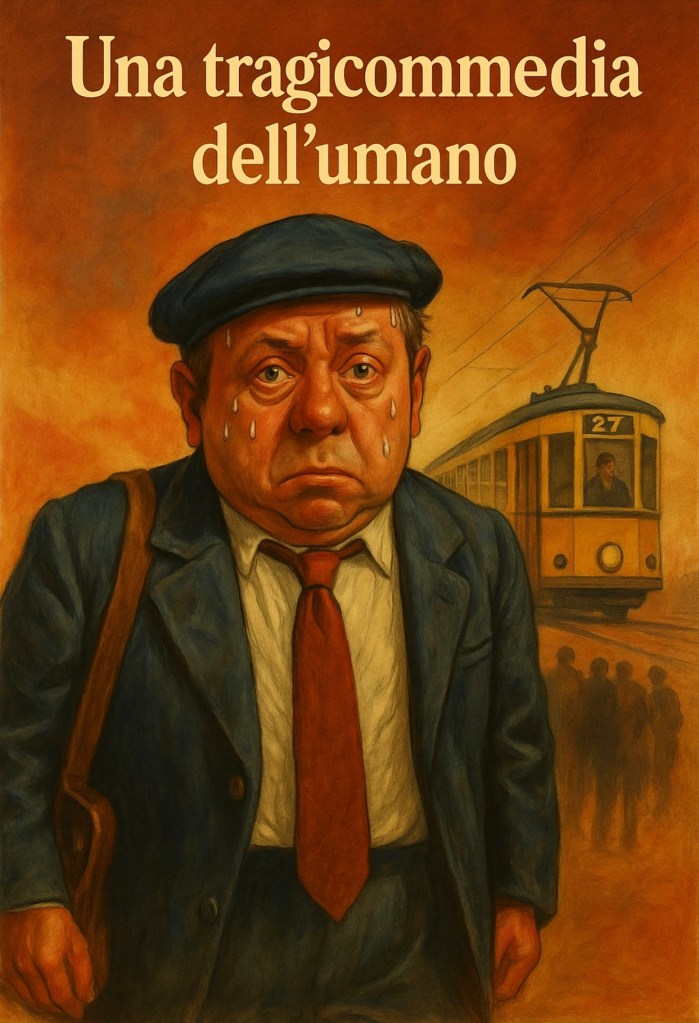
“Sveglia e caffè, barba e bidè, presto che perdo il tram…”
Un jingle che apre una saga comica, ma che, se ascoltato bene, vibra come un mantra isterico, alienato, tragico.
Un inno grottesco alla quotidianità: non è solo una canzoncina, ma una vera e propria dichiarazione d’esistenza.
Svuotata, meccanica, reiterata.
Una poesia dell’abitudine.
Una liturgia dell’ansia.
Dietro questa strofa, apparentemente idiota, si nasconde la tragedia dell’uomo moderno.
E non un uomo qualunque.
L’Uomo.
Con la maiuscola.
Fantozzi, infatti, non è una semplice maschera comica.
È un archetipo psichico.
Un condensato di ansie, rinunce, desideri infantili e sogni ridicoli.
È una rappresentazione estrema, e per questo esatta, della condizione psichica dell’uomo occidentale.
Un archetipo, non una macchietta
Nei gesti grotteschi, nelle frasi assurde, nelle espressioni esasperate, si manifesta l’essenza di un’esistenza spezzata: il desiderio che non osa mai diventare volontà, la sottomissione mascherata da obbedienza, la ribellione che si consuma prima ancora di accendersi.
Accanto alla moglie Pina, figura fusionale, asessuata, materna, Fantozzi insegue eternamente la signorina Silvani, fantasma erotico e caricatura del desiderio. Ma anche lì, come sempre, fallisce. E fallisce con dignità tragicomica.
A tenergli compagnia c’è Filini, il doppio deformato, l’“ancora più Fantozzi di Fantozzi”, a ricordarci che nella risata si annida la più precisa forma di compassione.
E poi ci sono loro: i Mega Direttori Galattici, le contesse assiderate, i colleghi pecoroni, i camerieri che umiliano, i capi che sorvegliano. Tutti personaggi che incarnano l’autorità delirante del Super-Io, che irride e schiaccia ogni pulsione di libertà.
Il tragicomico come forma di verità
Fantozzi è Candido di Voltaire, ma senza illusioni. È Sisyphos senza roccia, ma con la cravatta stretta e le calze di spugna. Ogni tentativo è votato al fallimento, eppure qualcosa si salva.
Si salva il gesto. Il lampo. La voce che si alza, una sola volta, per urlare: “La corazzata Potëmkin è una cagata pazzesca!”
Ecco l’epifania del tragicomico: un atto di verità assoluta, seguito da una punizione grottesca e da un nulla che ritorna. Ma in quel grido, qualcosa è accaduto.
L’uomo di oggi è più fantozziano di ieri
Nella società contemporanea, l’uomo è ancora più vicino al destino di Fantozzi. Non ha più i padroni visibili di un tempo. Non ha nemmeno bisogno di ribellarsi. È già piegato. Senza saperlo.
Non ci sono più i Mega Direttori. C’è l’algoritmo. Non c’è più la contessa Serbelloni Mazzanti Vien dal Mare. C’è l’influencer performante. E noi, tutti, ci siamo omologati a un’estetica globale, senza identità, senza sbavature. Tutti levigati. Tutti uguali. Tutti Fantozzi, ma senza la forza di riderne.
Ecco dove il personaggio diventa simbolo. Nel suo rimanere umano. Nel suo non adattarsi mai fino in fondo.
Fantozzi come soglia della verità
Fantozzi ci parla di una verità scomoda, ma autentica. Ci dice che si può essere ridicoli e veri. Sconfitti e profondi. Che si può amare anche nell’errore. Che la vita è tragicomica, e che proprio lì, tra il comico e il tragico, si annida la soglia dell’umano.
Villaggio lo aveva capito. E lo aveva scritto con una precisione quasi clinica. Un’ironia spietata, ma mai crudele. Un’umiliazione esibita, che diventa estetica dell’esistenza.
Ultima nota. Personale, ma non troppo
C’è chi, come mio padre, amava Fantozzi. Lo amava profondamente. E non solo rideva sempre (!) , rideva in quel modo totale e contagioso, ma, nel farlo, trasmetteva qualcosa. Io ho cominciato ad amare Fantozzi proprio così: ridendo di riflesso, contagiato da quella risata generosa e da uno sguardo complice, compiaciuto e penetrante. Non capivo ancora perché, ma intuivo che in quel riso c’era una verità.
Mio padre (non smetterò mai abbastanza di pensare quanto fosse meraviglioso mio padre!) lo guardava quasi commosso, perché in quell’uomo sudato, curvo, impacciato, vedeva in lui l’ultima forma di resistenza alla stupidità del mondo.
La sua goffaggine era una preghiera. Il suo fallimento, un’epifania.
Una risata che ci salva
Fantozzi mette in scena la tragicità della mediocrità, ma anche la sua bellezza. Racconta ciò che succede quando si tenta di essere seri in un mondo ridicolo, o viceversa. Ed è lì che si gioca tutto: tra il desiderio che non sa dove andare, tra il lavoro che non riconosce, tra i rapporti che si sfiorano senza toccarsi mai.
E allora sì, forse ha senso iniziare da una canzoncina come “sveglia e caffè, barba e bidet”, e farne il manifesto tragicomico dell’umano.
Perché il riso salva. Ma non salva da solo. Salva con lacrime nascoste.
E Fantozzi non è mai stato un pagliaccio. Fantozzi è, invero, la misura dell’originalità della vita.
ENGLISH
A Tragicomic Rêverie: Archetype, Desire, and Defeat
“Wake up and coffee, shave and bidet, hurry or I’ll miss the tram…”
A jingle that opens a comedic saga, but if you listen closely, it resonates like a hysterical, alienated, tragic mantra.
A grotesque anthem to daily life: not just a ditty, but a true declaration of existence.
Emptied, mechanical, repetitive.
A poetry of habit.
A liturgy of anxiety.
Behind this seemingly idiotic verse lies the tragedy of modern man.
Not just any man.
The Man.
With a capital M.
Fantozzi is not merely a comedic mask.
He is a psychic archetype.
A condensation of anxieties, renunciations, childish desires, and ridiculous dreams.
An extreme, and therefore accurate, representation of the psychic condition of Western man.
An Archetype, Not a Caricature
In grotesque gestures, absurd phrases, and exaggerated expressions, the essence of a broken existence manifests:
desire that never dares to become will,
submission masked as obedience,
rebellion that extinguishes before igniting.
Alongside his wife Pina—fusion figure, asexual, maternal—Fantozzi eternally chases Miss Silvani, an erotic phantom and caricature of desire.
But even there, as always, he fails.
And fails with tragicomic dignity.
His companion is Filini, the distorted double, the “even more Fantozzi than Fantozzi,” reminding us that within laughter lies the most precise form of compassion.
And then there are:
the Galactic Mega Directors,
the frozen countesses,
the sheep-like colleagues,
the humiliating waiters,
the supervising bosses.
All characters embodying the delirious authority of the Superego, mocking and crushing every impulse of freedom.
The Tragicomic as a Form of Truth
Fantozzi is Voltaire’s Candide, but without illusions.
He is Sisyphus without the rock, but with a tight tie and sponge socks.
Every attempt is doomed to failure, yet something is salvaged.
The gesture is saved.
The spark.
The voice that rises—just once—to shout:
“The Battleship Potemkin is an incredible load of crap!”
Here lies the epiphany of the tragicomic:
an act of absolute truth,
followed by grotesque punishment and a returning void.
But in that cry, something happened.
Today’s Man Is More Fantozzian Than Ever
In contemporary society, man is even closer to Fantozzi’s fate.
He no longer has the visible masters of the past.
He doesn’t even need to rebel.
He is already bent.
Unknowingly.
No more Mega Directors.
There’s the algorithm.
No more Countess Serbelloni Mazzanti Vien dal Mare.
There’s the performing influencer.
And we—all—have conformed to a global aesthetic, without identity, without smudges.
All polished. All the same.
All Fantozzi, but without the strength to laugh about it.
This is where the character becomes a symbol.
In his remaining human.
In his never fully adapting.
Fantozzi as a Threshold of Truth
Fantozzi speaks to us of an uncomfortable but authentic truth.
He tells us that one can be ridiculous and true.
Defeated and profound.
That one can love even in error.
That life is tragicomic, and that precisely there—between the comic and the tragic—lies the threshold of the human.
Villaggio understood this.
And he wrote it with almost clinical precision.
A ruthless irony, but never cruel.
An exhibited humiliation that becomes an aesthetic of existence.
Final Note. Personal, but Not Too Much
There are those, like my father, who loved Fantozzi.
He loved him deeply.
And not only did he always laugh, he laughed in that total and contagious way, but in doing so, he conveyed something.
I began to love Fantozzi just like that:
laughing by reflection, infected by that generous laughter and by a complicit, pleased, and penetrating gaze.
I didn’t yet understand why, but I sensed that in that laughter there was a truth.
My father (I will never stop thinking about how wonderful my father was!) watched him almost moved, because in that sweaty, hunched, clumsy man, he saw in him the last form of resistance to the stupidity of the world.
His clumsiness was a prayer.
His failure, an epiphany.
A Laughter That Saves Us
Fantozzi stages the tragedy of mediocrity, but also its beauty.
He tells what happens when one tries to be serious in a ridiculous world, or vice versa.
And that’s where everything plays out:
between desire that doesn’t know where to go,
between work that doesn’t recognize,
between relationships that brush against each other without ever touching.
And so yes, perhaps it makes sense to start with a little song like “wake up and coffee, shave and bidet,” and make it the tragicomic manifesto of the human.
Because laughter saves. But it doesn’t save alone. It saves with hidden tears.
And Fantozzi has never been a clown.
Fantozzi is, indeed, the measure of life’s originality.
(Psycho)Fantozzian Glossary
Fantozzi: the ridiculed self, constantly caught between desire and fear
Filini: the farcical, sadistic, unattainable Superego
Miss Silvani: sexualized partial object, idealized, always unreachable
Calboni: the unpunished narcissist, compensatory, almost mythological
Pina: mother-ark, fusion, accepted and denied asexuality
The Mega Directors: faceless authority, bureaucratic delirium of the Superego
The Countesses: the symbolic of class, form, death
The Battleship Potemkin: the moment of trauma and symbolic rebellion
The Tram: life that departs without us
 Reverie Sonore
Lascia un commento