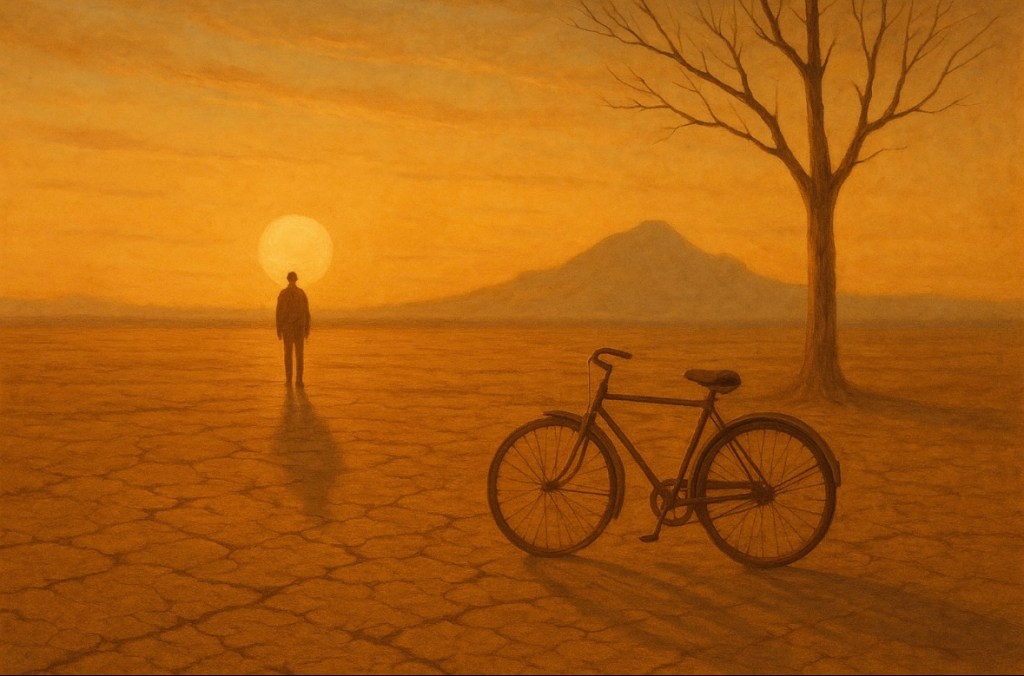
Un uomo e una bicicletta, tra la terra e il tramonto, nel silenzio del paesaggio che resta.
A man and a bicycle, between the earth and the sunset, in the silence of the landscape that remains.
ITALIANO
C’è qualcosa di irreparabile nei luoghi che restano quando le persone se ne vanno.
E Diavolo Rosso (cit. della celebre canzone di Paolo Conte) parla esattamente di questo: di ciò che resta quando tutto è già passato. È una canzone che ha il passo dei trattori, anzi, delle ruspe, delle biciclette senza cambio, degli uomini che non hanno mai avuto tempo per essere moderni. Eppure, oggi, anche oggi, ci parla.
Perché in questa storia apparentemente provinciale, sgraziata, persino burlesca in certi momenti, con quel cappello calato per “sentirsi un uomo”, si annida una verità antropologica definitiva:
L’uomo è il suo paesaggio. Non vive nel mondo. È mondo.
E qui non è questione di lirismo bucolico o nostalgia folclorica. No.
È che il soggetto umano non esiste senza incarnazione spaziale, senza atmosfera, senza paesaggio.
E il paesaggio, a sua volta, non è solo ciò che si vede, ma ciò che si sedimenta.
Nel corpo, nella psiche, nei ricordi, nella voce.
Per questo Diavolo Rosso non racconta la storia di un uomo. Racconta la storia di un luogo che continua a parlare anche quando l’uomo è finito.
Un luogo che conserva le tracce come una cicatrice, che porta dentro di sé le urla, i silenzi, gli odori, le solitudini.
È come camminare sulle stesse montagne dove camminavi con tuo padre. E scoprire che le montagne ci sono ancora. E tuo padre no.
Ed è tutto lì.
La psicoanalisi lo sa bene: questa asimmetria tra permanenza e perdita è uno dei traumi fondativi del pensiero umano.
È la mancanza primaria, la disillusione freudiana; è la morte che non si lascia negare, e che si ripresenta ogni volta che qualcosa ci sopravvive.
E allora ecco che torniamo lì: l’uomo che va sulla Luna, che modifica il DNA, che costruisce simulacri di realtà…
Ma continua a morire come sempre. Come un tempo.
Come un vecchio contadino sotto il sole.
Come un ciclista stremato in salita, come un padre che non rientra più a casa, come un figlio che non riesce a diventare uomo.
In questo senso, Diavolo Rosso non è affatto una canzone sul passato, ma sul tempo.
Su quel tempo in cui tutto muta e nulla cambia.
Perché le macchine si trasformano, ma la ferita umana è la stessa.
Lì dove l’insicurezza non è un errore del carattere, ma una verità dell’esistenza.
È per questo che l’analisi non può accontentarsi di parlare di sintomi, né la filosofia di concetti.
Serve uno sguardo che tenga insieme il biologico, il topografico, il simbolico, il corporeo.
Perché il paesaggio non è fuori: è l’ambiente che ci ha formato, è il fenotipo incarnato, è il genoma riscritto dall’esperienza, è la ferita che ci modella.
E questa ferita, questa struttura paesaggistica dell’anima, parla.
Parla come una canzone.
Parla come Diavolo Rosso.
Noi non possiamo più essere l’eroe solitario della modernità.
Siamo eredi.
Siamo resti.
Siamo biografie intessute di polvere, DNA e memoria collettiva.
Non possiamo fuggire dal paesaggio, perché è in noi.
E allora la clinica, la filosofia, la poesia devono fare pace con la terra.
Con il lutto. Con l’umiliazione. Con il tramonto. Con la pianura.
Solo così potremo rispondere, umilmente, alla domanda più urgente che ci accompagna da sempre:
Come si sopravvive al mondo che ci sopravvive?
Forse ascoltando il silenzio che rimane quando la musica si spegne.
Forse lasciando che il paesaggio interiore risuoni come una nota tenue, che non si dimentica.
ENGLISH
There is something irreparable in the places that remain when the people are gone.
And Diavolo Rosso (from the famous song by Paolo Conte) speaks exactly of this: of what endures when everything else has already passed. It is a song with the gait of tractors, or better, bulldozers, of gearless bicycles, of men who never had time to be modern. And yet, today, even today, it still speaks to us.
Because in this seemingly provincial, awkward story, sometimes even burlesque, with that hat pulled down to “feel like a man”—there lies a definitive anthropological truth:
Man is his landscape. He does not live in the world. He is world.
And this is not a matter of bucolic lyricism or folk nostalgia. No.
It’s that the human subject does not exist without spatial embodiment, without atmosphere, without landscape.
And the landscape, in turn, is not just what you see, but what settles and accumulates.
In the body, in the psyche, in memories, in the voice.
That’s why Diavolo Rosso does not tell the story of a man. It tells the story of a place that keeps speaking even when the man is gone.
A place that preserves traces like a scar, that carries within itself the screams, the silences, the smells, the solitudes.
It’s like walking the same mountains you once walked with your father. And discovering the mountains are still there. But your father is not.
And that’s everything.
Psychoanalysis knows this well: this asymmetry between what remains and what is lost is one of the founding traumas of human thought.
It is the primary lack, the Freudian disillusionment; it is death that cannot be denied, and that returns every time something outlives us.
And so, here we are again: man going to the Moon, modifying DNA, building simulacra of reality…
But still dying as always. As before.
Like an old farmer beneath the sun.
Like a cyclist exhausted on a climb, like a father who never returns home, like a son who cannot become a man.
In this sense, Diavolo Rosso is not a song about the past, but about time.
About that time in which everything changes and nothing changes.
Because machines transform, but the human wound remains the same.
Where insecurity is not a flaw of character, but a truth of existence.
That’s why analysis cannot be satisfied with talking about symptoms, nor philosophy with mere concepts.
We need a gaze that holds together the biological, the topographical, the symbolic, the bodily.
Because the landscape is not outside: it is the environment that formed us, the incarnated phenotype, the genome rewritten by experience, the wound that shapes us.
And this wound, this landscape structure of the soul, speaks.
It speaks like a song.
It speaks like Diavolo Rosso.
We can no longer be the solitary hero of modernity.
We are heirs.
We are remains.
We are biographies woven of dust, DNA, and collective memory.
We cannot escape the landscape, because it is within us.
And so, clinical work, philosophy, poetry must make peace with the earth.
With mourning. With humiliation. With sunset. With the plain.
Only then can we humbly respond to the most urgent question that has always accompanied us:
How do we survive the world that survives us?
Maybe by listening to the silence that remains when the music stops.
Maybe by letting the inner landscape resound like a faint note that cannot be forgotten.

 Reverie Sonore
Lascia un commento