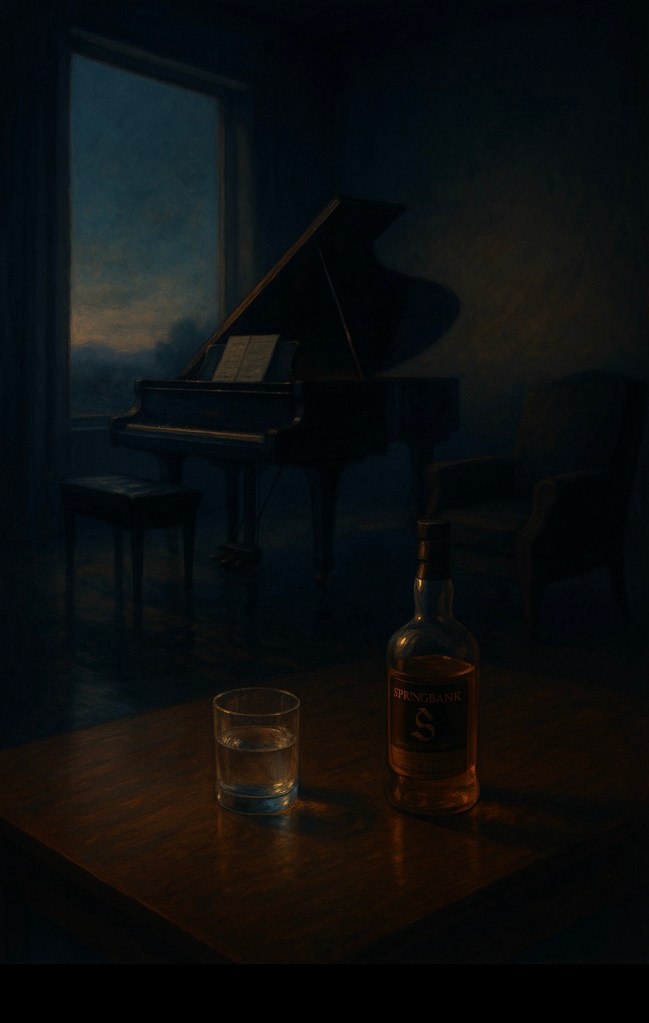
Sospensione tra musica, whisky e introspezione.
Suspended between music, whisky, and introspection.
Forse ogni tanto è giusto lasciarsi andare a una meditazione, a una trascendenza volontaria. Basta appoggiare le cuffie, schiacciare play e lasciare che il pianoforte trasparente e inarrivabile di Pascal Rogé, nell’Andante con moto del Concerto per pianoforte di Poulenc, sciolga i nodi dell’anima. Allora tutto il mondo delle rappresentazioni, delle sovrastrutture, dei piani frapposti scompare. Un bicchiere d’acqua fresco, ghiaccio, e una punta di Springbank, sì, proprio quel single malt ambrato, compagno di serate sospese e pensieri storti, citato anche da Barney Panofsky ne La versione di Barney. Oggi è di puro malto.
E anche se non raggiungeremo, o ci avvicineremo appena, alla verità personale, a questo punto volontariamente entriamo in un nuovo mondo, sospeso, pieno di chiaroscuri, di ombre volute, a tratti malinconico, ironico, forse fragile.
C’è una parola che oggi sembra non dire più nulla: verità. O forse, è proprio la verità personale a essersi dileguata, non per cospirazione o per gioco, ma per il modo in cui i piani della nostra esistenza si sono fatti così intricati, così innestati uno sull’altro da rendere la vita una trama di fili che nessuna mano può più dipanare.
Il piano biologico, con i suoi richiami oscuri e indifferenti; il piano culturale, stratificato come una geologia di parole, abitudini, posture; il piano dell’inconscio, quella materia nera che ci tiene in orbita senza mai mostrarsi davvero; il sociale, coi suoi occhi moltiplicati all’infinito che ci osservano, ci correggono, ci ricompongono. E poi i desideri, le paure, la pressione gentile ma implacabile di tutto ciò che non ci siamo scelti.
Ecco allora che l’essere umano, nell’impossibilità di afferrare la propria complessità, si rifugia quasi senza volerlo in una difensività latente, una postura dell’anima che lo protegge dal sentire troppo, dal vedere troppo, dal rischiare l’abisso del non sapere più chi sia. Si ripete nei gesti, negli atti linguistici, nelle micro-ritualità quotidiane: afferma “io” senza crederci davvero, racconta sogni che non osa vivere, chiede conferme allo sguardo dell’altro come un bambino che interroga la madre, l’amante, l’istituzione, lo smartphone.
La contemporaneità sembra aver dissolto ogni eco di questa complessità, non per negazione (che sarebbe ancora un atto di forza), ma per avversione: la profondità è divenuta sospetta, la modestia teoretica derisa, la ricerca di senso derubricata a debolezza vintage. Ciò che non si piega alla narrazione standardizzata viene reso ridicolo, addomesticato, smussato, o peggio ancora, ignorato.
Così, nuove e vecchie generazioni, ormai arrese, piegate o persino accoglienti rispetto al nuovo scenario, si sono lasciate edulcorare, diventando quasi sfondo, galleggiando tra discipline e oggetti, desideri addomesticati dal marketing, bisogni messi in rima con lo standard, emozioni pensate come emoji, relazioni offerte come menù degustazione. Tutto è normalità esibita, mai vissuta.
E allora, forse, il compito dell’arte e della psicoanalisi è proprio questo: ricercare il margine, il dettaglio eccentrico, l’opera che non si lascia normalizzare. Andare, con passo sottilmente polemico, a recuperare i grandi nomi eccentrici, i musicisti abnormi e visionari, i poeti che non stanno nella griglia, da Bartók a Sciarrino, da Messiaen a certi filosofi dell’incompiutezza. Quando i “brutti” e i frammentari, i non integrati, tornano a essere il deposito segreto di un surplus di umanità, di fascino, di erotismo, quell’eccesso vivo che la contemporaneità tenta ostinatamente di ridurre, normalizzare, risucchiare e svuotare nella comfort zone, allora forse si apre un varco per qualcosa che ci riguarda davvero.
Solo nell’esperienza estetica, che non consola ma scompiglia, che non semplifica ma turba, forse si può ancora sentire la tensione di una verità personale che si sottrae proprio perché non è rappresentabile, non è vendibile, non è addomesticabile.
Così, chi si concede ancora il lusso di perdersi in una rêverie musicale, poetica o persino in una conversazione scomoda, può forse intuire che ogni struttura difensiva, ogni linguaggio rituale, ogni identità esibita non è altro che il fragile guscio di una verità che, in fondo, resta sempre inavvertibile. Ed è proprio in questo scarto, in questa mancanza di padronanza, che l’umano resta tale.
Forse, in fondo, tutto quello che si può promettere, nell’epoca dell’inavverabilità, è la ricerca di una presenza, di una nota vera.
È come ascoltare l’Andante con moto del Concerto per pianoforte di Poulenc, sotto le dita trasparenti di Pascal Rogé: una melodia che si apre come un invito ma non si lascia mai davvero prendere, un’atmosfera che resta sospesa tra il ricordo, il sorriso e il non-detto.
È lì che la verità personale si annida: non nel compimento, ma nella tensione, nel margine, nell’eco che resta anche quando tutto sembra finito.
Reverie – The Unnoticeability of Personal Truth
Perhaps every now and then it is right to let oneself go, to surrender to meditation, to voluntary transcendence. All it takes is to put on the headphones, press play, and allow the transparent and unattainable piano of Pascal Rogé, in the Andante con moto from Poulenc’s Piano Concerto, to untie the knots of the soul. In that moment, the entire world of representations, superstructures, and layered planes vanishes. A glass of cool water, ice, and a dash of Springbank, yes, that very same amber single malt, companion of suspended evenings and wayward thoughts, also cited by Barney Panofsky in Barney’s Version. Today it is pure malt.
And even if we never reach, or scarcely approach, personal truth, at this point we willingly enter a new world, suspended, full of chiaroscuro, of chosen shadows, at times melancholic, ironic, perhaps fragile.
There is a word that today seems to have lost all meaning: truth. Or perhaps it is precisely personal truth that has slipped away, not through conspiracy or playfulness, but because the layers of our existence have grown so intricate and so interwoven that life has become a web of threads no hand can unravel.
The biological plane, with its dark and indifferent calls; the cultural plane, stratified like a geology of words, habits, postures; the plane of the unconscious, that dark matter keeping us in orbit without ever truly revealing itself; the social plane, with its eyes multiplied to infinity that observe us, correct us, recompose us. And then, desires, fears, the gentle yet relentless pressure of all that we did not choose.
Thus it happens that the human being, unable to grasp his own complexity, retreats almost involuntarily into a latent defensiveness, a posture of the soul that protects him from feeling too much, from seeing too much, from risking the abyss of no longer knowing who he is. He repeats himself in gestures, in linguistic acts, in the micro-rituals of daily life. He asserts “I” without truly believing it, narrates dreams he does not dare to live, seeks confirmation in the gaze of the other as a child questions mother, lover, institution, smartphone.
Contemporaneity seems to have dissolved every echo of this complexity, not through negation, which would at least be an act of force, but through aversion. Depth has become suspect, theoretical modesty derided, the search for meaning relegated to a vintage weakness. Whatever does not bend to the standardized narrative is rendered ridiculous, domesticated, smoothed out, or worse still, ignored.
And so, new and old generations alike, now resigned, subdued, or even welcoming of this new scenario, have allowed themselves to be sweetened and faded into the background, floating among disciplines and objects, desires domesticated by marketing, needs rhymed with the standard, emotions imagined as emojis, relationships offered as tasting menus. Everything is exhibited normality, never truly lived.
And so, perhaps, the task of art and psychoanalysis is precisely this: to seek out the margin, the eccentric detail, the work that resists normalization. To recover the great eccentric names, the abnormal and visionary musicians, the poets who do not fit within the grid, from Bartók to Sciarrino, from Messiaen to certain philosophers of incompleteness. When the ugly and the fragmentary, the non-integrated, once again become the secret depository of a surplus of humanity, of allure, of eros, that living excess which contemporaneity stubbornly tries to reduce, normalize, absorb, and drain within the comfort zone, then perhaps a breach opens for something that truly concerns us.
Only in aesthetic experience, which does not console but unsettles, which does not simplify but disturbs, can one perhaps still feel the tension of a personal truth that withdraws precisely because it cannot be represented, cannot be sold, cannot be domesticated.
Thus, those who still allow themselves the luxury of getting lost in a musical or poetic reverie, or even in an uncomfortable conversation, may sense that every defensive structure, every ritualized language, every performed identity is nothing more than the fragile shell of a truth that, in the end, always remains unnoticeable. And it is precisely in this gap, in this lack of mastery, that the human remains truly human.
Perhaps, ultimately, all that can be promised in this era of unnoticeability is the search for a presence, for a genuine note.
It is like listening to the Andante con moto from Poulenc’s Piano Concerto, beneath the transparent fingers of Pascal Rogé. A melody that opens like an invitation yet never lets itself be fully grasped, an atmosphere suspended between memory, a smile, and the unspoken.
It is there that personal truth lies hidden: not in fulfillment, but in tension, in the margin, in the echo that remains even when all seems to have ended.
 Reverie Sonore
Lascia un commento