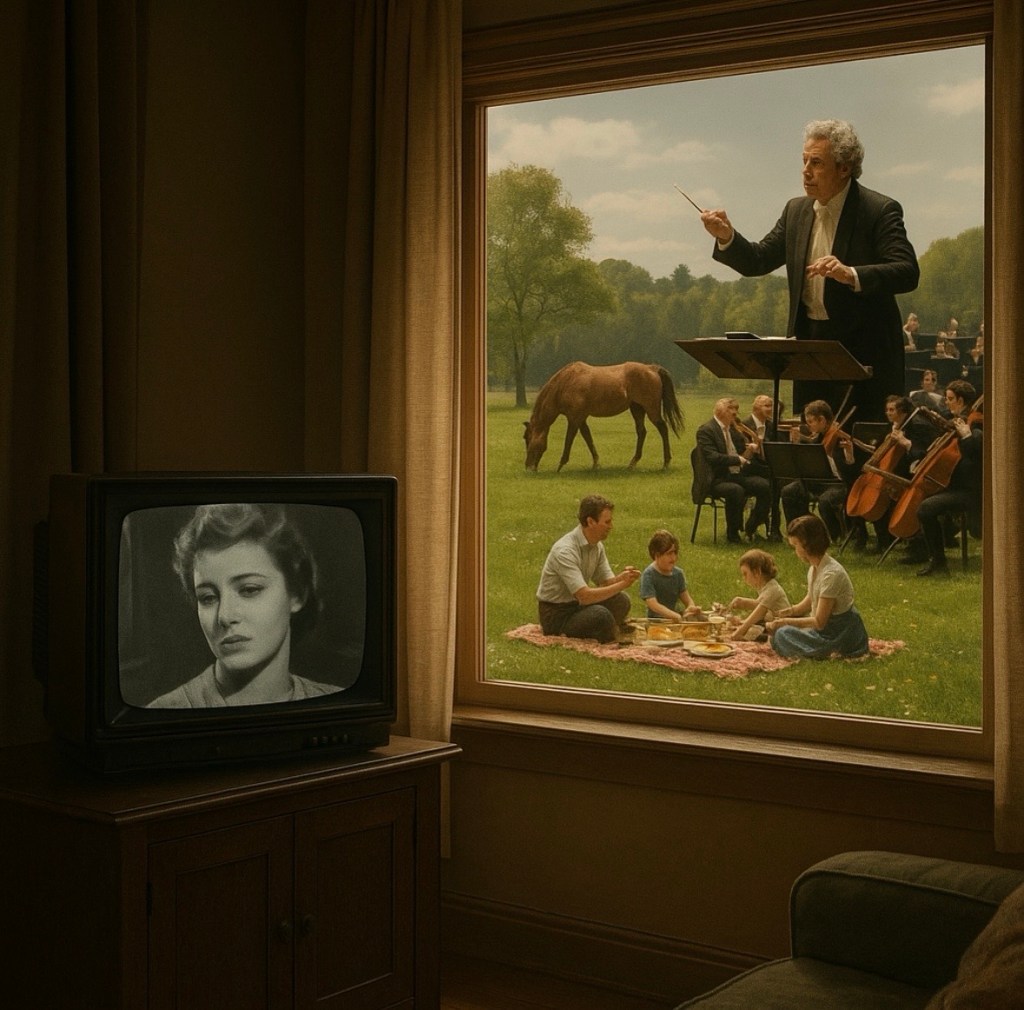
Un pomeriggio che non finisce: la musica entra nella stanza, la memoria resta alla finestra.
An endless afternoon: music fills the room while memory lingers by the window.
Ci sono esecuzioni di Mahler che ti costringono a piangere, altre ad essere fieri nella dignità o nella commozione, altre che ti chiedono di capire.
Poi c’è quella di Ozawa, che ti invita semplicemente a restare.
Nessuna redenzione, nessun abisso: solo un pomeriggio che non finisce mai, una malinconia che sa di luce e di fieno.
Mahler 9 secondo Ozawa: la giumenta e la malinconia del sole
C’è un Mahler che non trafigge, che non punta al cielo con drammaticità ascensionale né scava nell’abisso, ma rimane, controintuitivamente, sulla terra.
Di più ancora: disteso in un prato, in un simbolico picnic tra sandwich, sidro e torta di mele; un là fuori contaminato di profumi domestici.
È il Mahler di Ozawa, dove la malinconia non piange, scivola giù, si deposita sul palato dell’anima, come qualcosa da gustare.
I colori oscillano tra il chiaroscuro e la luce fioca; il bianco e nero è quello di un vecchio film proiettato ciclicamente, un loop continuo che tinge la stanza dei suoi riflessi e conserva il calore di un pomeriggio perenne.
Non c’è dramma, ma un lento trascolorare della luce: l’essere che, invece di elevarsi o precipitare, rimane.
Da quella stanza, una finestra illumina un paesaggio bucolico in cui compare una giumenta fiera e quieta, ma non addomesticata.
È la figura di una libertà trattenuta, di una forza che conosce la calma senza rinunciarvi.
Cammina, bruca, inspira la libertà dell’aria: esiste.
Dove la vacca è la pace, la giumenta è il respiro del mondo, la mansuetudine attraversata da una vibrazione interiore, il corpo che ancora ricorda la corsa.
Forse Ozawa la ascolta dentro la sua orchestra: nelle corde che ondeggiano come erba mossa dal vento, nei fiati che sanno di fieno e di tramonto.
La condensa tutta nella sua capacità di contenere, più ancora che di dirigere: concentrata nei gesti, sublimata nel suono orchestrale.
La Nona diventa così un’esperienza palatativa, una musica che non si contempla ma si assapora: il terzo movimento, quello compiuto dal fruitore.
Da questa posizione si assapora il fuori, la terra, il fieno, e il dentro: la torta di mele, il sidro.
È l’uomo che non sceglie l’animalità, ma la calibra, la riconcilia con la forma: il pensiero che ha smesso di pensare e ora semplicemente vive della propria dolcezza.
Non è più l’animale che dunque sono, ma, come ha scritto un filosofo del nostro tempo¹, l’animale che dunque non sono: quella parte di me che, proprio perché non si dissolve nell’istinto, può abitarlo, riconciliarlo, trasmutarlo in coscienza terrena.
E in questo equilibrio fragile fra pensiero e respiro, fra forma e terra, la malinconia non si risolve ma si apre, come un tramonto che non conosce fine.
Si può essere matti come cavalli, difficilmente come vacche, e Ozawa, con la sua leggerezza malinconica, ci ricorda che la follia del mondo è, talvolta, soltanto una grazia che non vuole più galoppare.
Forse è proprio in questo punto che la musica di Mahler tocca qualcosa dell’esperienza analitica.
Non interpreta, non spiega, ma lascia che il tempo si trasformi in presenza, come accade nella stanza d’analisi quando un vissuto viene accolto, pensato e trasformato nel legame con l’altro.
¹ Giovanni Gurisatti, L’animale che dunque non sono, Università di Padova, 2022.
Postludio. Forma, memoria e intersoggettività
In questa prospettiva, la formatività del vivere non cancella l’après-coup freudiano, ma lo reinterpreta: la forma che si produce nel presente è sempre percorsa da una memoria che non si conosce ancora.
È come se ogni gesto del vivere contenesse un’eco che lo precede e lo prolunga, una risonanza che si forma solo nel legame con l’altro.
L’intersoggettività psicoanalitica nel qui e ora della trasformazione non è estranea a questa estetica, ne è la sua tensione più umana: la forma che si plasma nella relazione.
Nella musica di Ozawa, come nell’incontro analitico, il tempo non è un punto ma una vibrazione: un presente che trattiene il passato e, nel farlo, ne genera la possibilità.
Non c’è contrapposizione tra memoria e immanenza, ma una coappartenenza.
La forma sonora, come la forma psichica, si dà solo nella durata condivisa, dove l’esperienza diventa figura e la figura esperienza vivente.
Soglia. L’ascolto come atto
Ogni gesto poetico nasce da un ascolto.
Non da un’ispirazione vaga, ma da una postura: quella di chi si lascia attraversare da ciò che percepisce senza ancora saperlo dire.
È, in fondo, lo stesso movimento che anima l’incontro analitico: qualcosa accade, si sposta, prende forma, e solo dopo trova parole.
Questa è la nostra intenzione: segnalare, non spiegare; evocare, non ridefinire.
Non descrive Mahler o Ozawa, ma l’esperienza che li attraversa: il modo in cui la musica, come ogni relazione viva, ci costringe a diventare forma mentre ascoltiamo.
L’ascolto, allora, non è un atto contemplativo, ma un’esperienza del divenire.
È già, in sé, un piccolo lavoro analitico e poetico che incide sulla materia del tempo.
Cosa ascoltare
Seiji Ozawa dirige Gustav Mahler, Sinfonia n. 9 in re maggiore, con la Boston Symphony Orchestra (Deutsche Grammophon, 1977).
Un’esecuzione ampia, terrestre e malinconica, dove ogni suono sembra respirare con la luce del pomeriggio.
Plural Mahler and the Mare
There are performances of Mahler that make you weep, others that fill you with dignity or emotion, and others that ask you to understand.
Then there is Ozawa’s, which simply invites you to stay.
No redemption, no abyss: only an afternoon that never ends, a melancholy that smells of sunlight and hay.
Mahler 9 according to Ozawa: the mare and the melancholy of the sun
There is a Mahler that does not pierce, that does not reach upward with dramatic ascent or dig into the abyss, but remains, counterintuitively, on the earth.
Even more: lying in a meadow, in a symbolic picnic of sandwiches, cider, and apple pie, an outdoors tinged with domestic scents.
This is Ozawa’s Mahler, where melancholy does not cry but slides down, settling on the palate of the soul like something to be savored.
The colors shift between chiaroscuro and dim light; the black and white is that of an old film projected in an endless loop, tinting the room with its reflections and preserving the warmth of an everlasting afternoon.
There is no drama, only a slow fading of the light: being that, instead of rising or falling, simply remains.
From that room, a window lights a bucolic landscape where a mare appears, proud and calm, yet unbroken.
She is the image of restrained freedom, of strength that knows serenity without surrendering to it.
She walks, grazes, breathes in the freedom of the air: she exists.
If the cow is peace, the mare is the breath of the world, gentleness traversed by an inner vibration, the body that still remembers the run.
Perhaps Ozawa hears her within his orchestra: in the strings swaying like grass in the wind, in the winds that smell of hay and sunset.
He gathers it all in his ability to contain rather than conduct, concentrated in gesture, sublimated in orchestral sound.
The Ninth thus becomes a palatable experience, a music not to be contemplated but savored, the third movement, the one completed by the listener.
From this position one tastes the outside, the earth, the hay, and the inside, the apple pie, the cider.
It is the human being who does not choose animality but calibrates it, reconciles it with form: thought that has stopped thinking and simply lives on its own sweetness.
It is no longer the animal that therefore I am, but, as a philosopher of our time¹ has written, the animal that therefore I am not, that part of me which, precisely because it does not dissolve into instinct, can inhabit it, reconcile it, transmute it into earthly consciousness.
And in this fragile balance between thought and breath, between form and earth, melancholy does not resolve but opens, like a sunset without end.
You can be mad like horses, rarely like cows, and Ozawa, with his melancholy lightness, reminds us that the madness of the world is sometimes only a grace that no longer wishes to gallop.
Perhaps it is precisely here that Mahler’s music brushes against the analytic experience.
It does not interpret or explain, but lets time turn into presence, as happens in the analytic space when an experience is received, thought, and transformed within the bond with the other.
¹ Giovanni Gurisatti, L’animale che dunque non sono, University of Padua, 2022.
Postlude. Form, memory and intersubjectivity
In this perspective, the form-giving nature of life does not erase the Freudian après-coup but reinterprets it: the form that arises in the present is always traversed by a memory not yet known.
It is as if every gesture of living contained an echo that precedes and extends it, a resonance formed only in relation with the other.
Psychoanalytic intersubjectivity, in the here and now of transformation, is not foreign to this aesthetic; it is its most human tension, the form that takes shape within relation.
In Ozawa’s music, as in the analytic encounter, time is not a point but a vibration: a present that holds the past and, in doing so, generates possibility.
There is no opposition between memory and immanence but a co-belonging.
Sound form, like psychic form, exists only within shared duration, where experience becomes figure and figure becomes living experience.
Threshold. Listening as act
Every poetic gesture is born from listening.
Not from vague inspiration but from a posture, that of one who lets himself be crossed by what he perceives before he can name it.
It is, after all, the same movement that animates the analytic encounter: something happens, shifts, takes form, and only later finds words.
This is our intention: to signal, not to explain; to evoke, not to redefine.
It does not describe Mahler or Ozawa but the experience that passes through them, the way in which music, like every living relation, forces us to become form while listening.
Listening, then, is not a contemplative act but an experience of becoming.
It is already, in itself, a small analytic and poetic work that leaves its mark on the matter of time.
What to listen to
Seiji Ozawa conducts Gustav Mahler, Symphony No. 9 in D major, Boston Symphony Orchestra (Deutsche Grammophon, 1977).
A spacious, earthy and melancholic interpretation, where every sound breathes with the light of afternoon.
 Reverie Sonore
Lascia un commento