Umano troppo (poco) umano
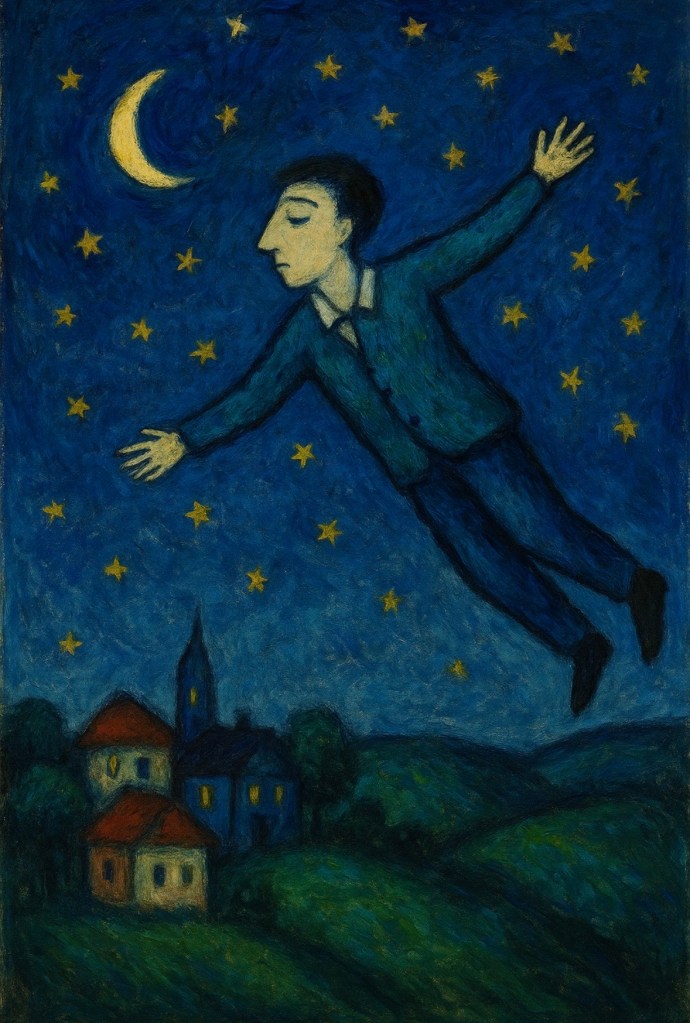
L’uomo che vola sopra la città, tra sogno e ferita, cerca nel cielo la forma possibile della vita.
The man flying above the city, between dream and wound, seeks in the sky the possible shape of life.
Quando una vita non basta, oltre il trauma incontriamo un “uomo che vola”.
Da ascoltare con: Peter Vasks, “Musica Serena” (1991)
Lo sguardo incerto, l’andatura rigida, il collo dritto,
la postura necessaria di chi la vita la scansa sul nascere,
di chi teme il contatto più del vuoto.
L’ironia è tagliente, mai allegra,
un gesto di difesa, un riflesso automatico,
parallelo al corpo che si tende per non cedere.
È la passività agita come aggressione sottile,
la concessione minima di un’interiorità immobile,
la vitalità che si spegne per non bruciare.
Eppure, dietro il pensiero, oltre l’immagine,
qualcosa pulsa ancora.
Non può essere nominato, perché nominare è già riaprire la ferita,
la vita richiama il trauma che è stata, il lutto irrappresentabile.
Ma nel corpo, nel respiro calmo che si impone anche a chi non vuole più respirare,
qualcosa passa, buca lo schermo della difesa.
È la vita che ancora rischia, anche contro la volontà di chi la abita.
Lì ci incontreremo, umani,
forse ancora impauriti,
ma vivi.
Coazione di vita
Ogni incontro umano è un ritorno,
ma non al passato, bensì al punto in cui la vita si è spezzata, disarticolata, irrigidita.
È lì che il tempo ricomincia, ogni volta,
ogni tempo sembra una nuova vita che si ripete.
In ciascuno di noi il lutto del padre,
del padre reale, del padre simbolico, del padre interiore,
continua a vibrare come una ferita che chiede di essere abitata, non guarita.
E quando riconosciamo questa vibrazione nell’altro, qualcosa si apre,
il dolore smette di essere soltanto nostro e diventa linguaggio comune,
compresenza dell’assenza, dono in sottrazione.
Come si può allora abitare insieme l’impossibilità dell’esistere autentico?
La vita non è che una serie di ripetizioni imperfette,
scene che ritornano per essere riscritte,
parole che si riaccendono dove erano cadute.
Nella ripetizione c’è l’eco della coazione,
ma anche il germe della libertà,
la possibilità di trasformare la necessità in gesto, la ferita in voce.
Bion direbbe che in quell’istante si lavora in O,
si resta davanti all’incomprensibile senza distruggerlo, senza poterlo digerire.
Masullo direbbe che si diventa etici,
perché solo dal patire nasce la comunità dell’essere.
Deleuze che le vie di fuga rappresentano sempre la possibilità di abitare l’impossibile.
E così, anche fuori dal setting,
anche nel silenzio delle vite parallele,
il transfert continua, non come malinteso ma come possibilità di osare,
di usare la vita dell’altro come fosse anche nostra,
il trauma come specchio di ogni propria ferita,
non per guarire assieme,
ma per rischiare di rendere abitabile ciò che della vita resta.
È la vita che, ancora una volta, tenta di essere tale attraverso o malgrado l’altro.
La neve dell’uomo che resta e il volo
Camminare sprofondando nella neve è sempre stato un sollievo,
simula la fatica inutile del vivere,
applica un’inerzia aggiuntiva che l’esperienza ha reso compagnia fedele.
Vorrei spiccare il volo, su, su, su,
sognando con tutte le mie forze tutte le esperienze che non ho vissuto e che non vivrò.
Su, su, su, ci deve essere un punto, forse nel cielo,
non più nella terra, dove non fa più male.
Dove essere soli è solo pace.
Quella pace che invento, creo, metto in scena,
e che non ho mai veramente più sentito da quando non ci sei.
Non ho più potuto amare perché non potevo piangere per te,
e tutto questo inespresso è potuto allora solo diventare respiro.
Allora lì mi incontrerai, nella calma,
nella vita che apparentemente fluisce,
io lascerò che sia il vuoto ad invadermi, a vivere al mio posto,
solo così sarò io l’assenza,
e tu (che non ci sei) ed io, saremo vicini.
Puoi vedermi ora, padre?
Amare è tradire
Ti ricordi quella sera, quella ragazza?
Quella a cui piaceva tanto quella canzone che odiavi?
E ricordi come, dal giorno dopo, quella stessa canzone hai cominciato ad ascoltarla?
Ascolto dopo ascolto, quella distanza si è fatta presenza,
quel modulare la voce da fastidio è diventato emozione.
Puoi ricordarlo ancora?
Forse è questo: amare è tradire la propria vita (in-difesa),
e restare lì, nel silenzio, a respirarla.
Nota dell’autore
La frattura netta di ogni sezione non è un errore di ritmo, ma è il modo in cui la vita entra nel testo.
Ogni passaggio segna un cambio di voce: l’osservatore, il pensiero, il corpo, l’amore.
Non esistono transizioni morbide tra questi luoghi dell’esistere: abitarli significa dispiegarli, non fonderli.
È lì che l’umano, dentro il limite, può sfiorare la libertà di tradire la difesa.
English
THE MAN WHO FLIES
Human, too (little) human
When one life isn’t enough, beyond trauma we meet “the man who flies.”
To listen with: Peter Vasks, “Musica Serena” (1991)
An uncertain gaze, a rigid gait, a lifted neck,
the posture of one who sidesteps life at its birth,
who fears contact more than emptiness.
Irony is sharp, never joyful,
a gesture of defense, an automatic reflex,
like the body tensing not to fall apart.
It is passivity acting as subtle aggression,
the smallest concession of an immobile interior life,
vitality fading not to burn.
And yet, behind thought, beyond the image,
something still beats.
It cannot be named, for naming reopens the wound,
life summons the trauma it once was, the unrepresentable loss.
But in the body, in that calm breath that insists
even in those who no longer wish to breathe,
something passes through, piercing the veil of defense.
It is life still risking itself, even against the will of its inhabitant.
There we shall meet, human,
perhaps still afraid,
but alive.
Compulsion of life
Every human meeting is a return,
not to the past, but to the point where life fractured, froze, withdrew.
There time begins again, each time,
each time seems a new life repeating itself.
In each of us the mourning of the father
real, symbolic, interior
vibrates as a wound asking to be lived, not healed.
And when we recognize that vibration in the other, something opens,
pain ceases to be only ours and becomes a shared tongue,
a co-presence of absence, a gift of subtraction.
How can we dwell together in the impossibility of true existence?
Life is but a series of imperfect repetitions,
scenes returning to be rewritten,
words rekindled where they once fell.
In repetition lies the echo of compulsion,
but also the seed of freedom,
the chance to turn necessity into gesture, the wound into voice.
Bion would say that in that instant one works in O,
remaining before the incomprehensible without destroying it, without digesting it.
Masullo would say one becomes ethical,
for only through suffering is the community of being born.
Deleuze that every line of flight is the possibility of dwelling the impossible.
And so, even beyond the setting,
even in the silence of parallel lives,
transference continues, not as misunderstanding,
but as the courage to dare,
to use another’s life as if it were one’s own,
the trauma as a mirror of one’s own wound,
not to heal together,
but to risk making habitable what of life remains.
It is life once more, attempting to exist through, or despite, the other.
The snow of the man who remains, and the flight
Walking, sinking into the snow, has always been a relief,
it mimics the useless fatigue of living,
adds an inertia that experience has turned into a loyal companion.
I wish I could take flight, up, up, up
dreaming with all my strength of the lives I never lived and never will.
Up, up, there must be a point, perhaps in the sky,
no longer in the earth, where pain no longer reaches.
Where solitude is only peace.
That peace I invent, I stage,
and have never truly felt since you left.
I could no longer love because I could not weep for you,
and all that unspoken turned at last into breath.
There you will find me, in calm,
in the life that seems to flow on,
I will let the void invade me, live in my place,
only thus will I be the absence,
and you (who are not) and I will be near.
Can you see me now, father?
To love is to betray
Do you remember that night, that girl?
The one who loved the song you hated?
And how, the next day, you began to listen to it?
Listen after listen, distance became presence,
that voice you found grating turned into pulse.
Can you still remember?
Perhaps this is it: to love is to betray one’s own life (un-defended),
and remain there, in silence, breathing it.
Author’s note
The sharp fracture of each section is not a flaw in rhythm, but the way life enters the text.
Each passage marks a change of voice: the observer, thought, the body, love.
There are no soft transitions between these places of existence: to inhabit them means to unfold them, not to merge them.
It is there, within the limit, that the human can touch the freedom of betraying its own defense.

 Reverie Sonore
Lascia un commento