ITA ENG BELOW
Rêverie su “La Compagnie de Catherine” (Vladimir Cosma)
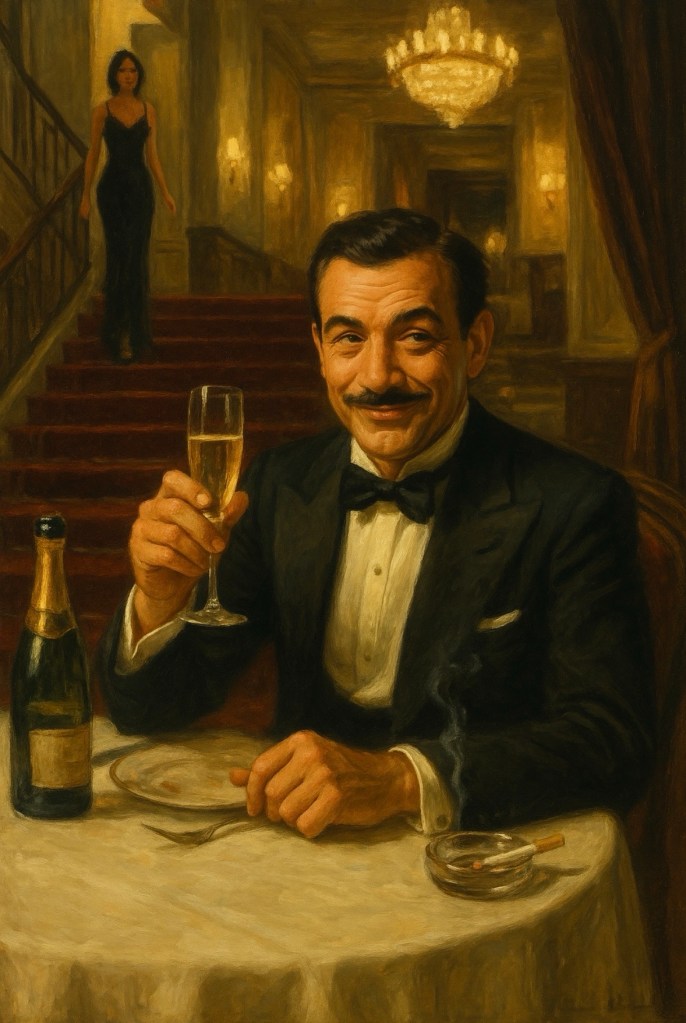
Un uomo in frac, solo nella sala di un hotel che ricorda il passato.
Un sorriso, un bicchiere, una risata che scivola nella malinconia.
A man in evening tails, alone in a hotel that remembers its past.
A smile, a glass, a laugh fading into melancholy.
Consiglio d’ascolto
Brano: La Compagnie de Catherine
Compositore: Vladimir Cosma
Album: Le Bal – Bande originale du film
Anno: 1983
Versione consigliata: Orchestra Nazionale di Francia, diretta dallo stesso Cosma
Durata: 3’42”
Ascoltatela dall’inizio, con un volume medio-basso, lasciando che la tromba apra la scena come un sipario su velluto.
La rêverie nasce esattamente da lì, da quel sorriso musicale che si piega in malinconia e si risolleva con ironia sottile.
È un valzer in dissolvenza, un ricordo che non appartiene a nessuno, e proprio per questo a tutti.
Reverie
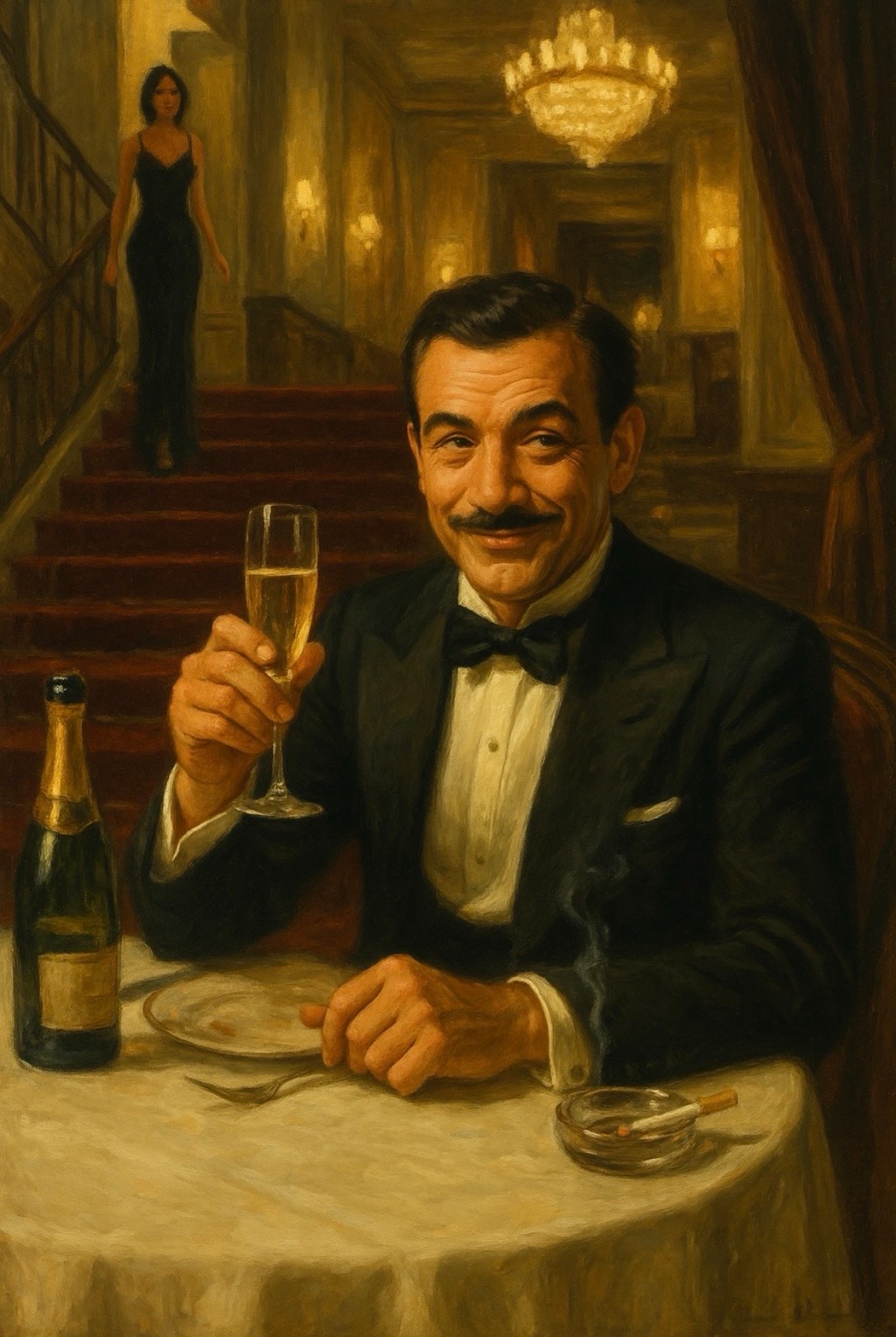
Un corridoio lucido di silenzi, il suono ovattato delle posate d’argento e delle scarpe lustrate che non sanno più se obbedire alla festa o alla malinconia.
Un uomo in frac, il nodo della cravatta che scivola appena.
Sorride, come si sorride a un cameriere che non si vedrà mai più o a un ricordo che torna a chiedere credito.
L’espressione mai rilassata rivela la sprezzatura dell’animo, la gioia mai compagna fedele.
Le perdite? Derubricate a posture esistenziali su cui sorridere appena, ironia malinconica.
Lui in frac, il bicchiere in mano, il cameriere che si inchina con troppa grazia, le luci troppo morbide e la musica di La Compagnie de Catherine che accompagna senza chiedere di più.
È il lusso come redenzione e difesa, la spesa come rito apotropaico.
Tognazzi, sì, proprio lui, sa benissimo che sta buttando via i risparmi di una vita, ma proprio in quell’atto li restituisce alla vita.
Li sublima nel corpo, perché se vita deve essere, può essere solo qui e ora.
Ogni nota di quella musica fa la stessa cosa, si offre e si consuma in un sorriso.
È lì che sogno e allucinazione si inseguono, si deformano, si schivano, la forma che sa di essere vana ma si concede lo splendore dell’istante.
La malinconia imprime vigore nel bere quell’afflato di vita alcolico e vagamente nauseante.
Eleganza, tenerezza, un filo di tragicommedia e quella compostezza che non molla neanche nella rovina.
Il ritmo e la struttura sembrano ripetersi troppo a lungo, la tromba accarezza il tamburellare delle dita sul bicchiere.
Non è tristezza, è il gesto stesso di trattenere, di stare nella vita come fosse già farsa, come se il giudizio fosse appiccicato al gesto al punto che nessun’altra interpretazione è possibile.
Una condanna, una confessione.
La vita sfugge dalle dita, ma è meglio così.
Il sorriso laterale, ruffiano ma implacabile, lo testimonia.
È uno swing disconsolato dell’anima, non quello della profondità, ma del sentire amaro e corrotto, quando la vita si torce ma dalla giusta distanza appare più bella che mai, più densa, ammaccata, più personale di così non può essere.
Fuori, la notte è una pellicola consumata.
Dentro, le luci dell’albergo riflettono un’eleganza ormai svuotata di ragione, che rende l’atmosfera obsoleta e cupa.
Tutto sembra il riflesso perfetto della moquette bordeaux scuro, in cui la polvere pare parte della trama stessa.
Ogni bicchiere è un piccolo altare di vetro, ogni sorso un frammento di giovinezza autentica, ritrovata e subito persa.
E lui lo sa.
È proprio questo che lo fa sorridere, quasi con dolcezza, certo con guizzo autoironico, e in questa discreta superiorità di chi può rinunciare alla narrazione comune, ma mai a una qualche anche anarchica forma di sé.
Nel rumore discreto delle stoviglie che filtrano dalle cucine, torna in chiusura il pensiero che dopotutto non è così male finire la vita in musica, con addosso ancora la misura del gesto e la voglia di sbagliare con stile.
Accende un’altra sigaretta, aspira insieme al fumo quell’aria che solo allora sembra più pura, vera.
Lei sta per scendere, per raggiungerlo al tavolo: troppo giovane per restare, troppo bella per non soffrire.
L’amore? Chi lo ricorda più?
La cena deve ancora cominciare, ma è già brillo.
E la notte… forse è già finita.
La poesia, se c’è mai stata, è tutta lì.
La forma del desiderio: amaro (Averna?) il gusto pieno della vita
L’uomo in frac, la musica che lo accompagna e lo redime, non sono figure narrative: sono configurazioni del desiderio.
Quando il vuoto non è rinuncia ma scarto necessario, il bluff del giocatore che, dopo essersi seduto in disparte ad osservare, rientra in gioco mentre gli altri si distraggono, non rinnovato, non rifiorito, ma più se stesso che mai.
È il rifiuto dell’etica del vivere per svincolarsi dal dono-vincolo del riconoscimento: il perdersi per esistere ancora.
Laddove il desiderio non trova più un oggetto reale a cui rivolgersi, si sublima in gesto, in forma, in rito, in eleganza ruffiana e “assurda”.
È la funzione estetica del lutto: la psiche, privata dell’oggetto, non cade nel vuoto ma lo ricrea in scena, lo fa esistere come immagine vivente.
Nella rêverie il gesto del personaggio non è un vezzo, ma un atto di autoconservazione simbolica.
Spendere, dissipare, sorridere: sono modi di ritrovare sé stessi attraverso la perdita.
Freud parlerebbe del lavoro del lutto, Bion di un atto di pensiero che trasforma il dolore in “figura”.
E ancora Hegel: il soggetto diventa reale solo nel momento in cui si vede perdersi nella forma, la negazione come compimento.
L’ironia tagliente, velata da un’eleganza grottesca, è allora la coscienza estetica del limite.
Non c’è dramma, perché la tragedia è già stata attraversata: resta il gesto che la racconta mentre la disinnesca.
Come direbbe Adorno, l’eleganza è ciò che resta del dolore quando il dolore ha imparato la misura.
È l’amaro che ti rimane in bocca dopo il primo caffè della vita: se non lo rifiuti, cominci ad amarlo.
Non perché buono, ma perché diverso, adulto, una ferita dell’ovvietà che sposta il livello di coesione e apre a nuove, mature possibilità di esistere, o di negare potere all’esistere predeterminato.
La filosofia ci aiuta a leggere questo come un atto di libertà fragile: l’uomo che, non potendo possedere la vita, la rappresenta, e nel rappresentarla la salva, ma salvandola si perde ancora.
La psicoanalisi mostra che questa rappresentazione è un atto psichico vitale, l’illusione consapevole come cura.
Non è difesa, è pensiero incarnato.
Così la musica, e con essa il gesto, il lusso, il sorriso, non maschera la mancanza: la trasforma in esperienza condivisibile, ma per questo anche vuota, superficiale, incoerente.
È in quell’attimo in cui il desiderio riconosce la propria finitezza e decide comunque di danzare che nasce la poesia: l’ultimo brivido di vita post-adolescenziale, il momento in cui la forma del pensiero coincide con la forma del vivere.
L’orchestra tace, resta solo il tintinnio dei bicchieri.
E un uomo che, nel silenzio, continua a sorridere, con un ghigno che dolcemente si allarga fino a farsi risata fragorosa, solitaria, liberatoria.
Qualche lacrima scorre, forse di gioia, forse di resa.
Nel gesto che resta, la vita trova ancora una forma.
E nella forma, forse, un’ultima tenerezza del pensiero.
ENGLISH
Tognazzi in tails
Rêverie on “La Compagnie de Catherine” (Vladimir Cosma)
Listening suggestion
Piece: La Compagnie de Catherine
Composer: Vladimir Cosma
Album: Le Bal – Original Motion Picture Soundtrack
Year: 1983
Recommended version: Orchestre National de France, conducted by Vladimir Cosma
Duration: 3’42”
Start from the very beginning, at medium-low volume, and let the trumpet open the scene like a velvet curtain.
This reverie was born exactly there, from that musical smile that bends into melancholy and rises again with subtle irony.
It is a waltz fading in slow motion, a memory that belongs to no one, and therefore to everyone.
Reverie
A polished corridor of silences, the muffled sound of silver cutlery and polished shoes that no longer know whether to obey the celebration or the melancholy.
A man in evening tails, the knot of his tie slipping slightly.
He smiles, the way one smiles at a waiter one will never see again, or at a memory returning to claim its due.
His expression, never relaxed, reveals the studied nonchalance of the soul, joy never a faithful companion.
Losses? Relegated to existential postures, smiled at with faint melancholic irony.
He in tails, a glass in his hand, the waiter bowing with too much grace, the lights too soft, and the music of La Compagnie de Catherine accompanying without asking for more.
Luxury as redemption and defense, spending as an apotropaic rite.
Tognazzi, yes, that very Tognazzi, knows perfectly well he is wasting the savings of a lifetime, yet in that very act he returns them to life.
He sublimates them through the body, for if life must be, it can only be here and now.
Every note of that music does the same, offering itself and vanishing in a smile.
There, dream and hallucination chase, distort, and dodge each other, form aware of its own vanity yet conceding itself the splendor of the instant.
Melancholy lends vigor to the act of drinking that alcoholic, faintly nauseating breath of life.
Elegance, tenderness, a trace of tragicomedy, and that composure which never abandons even the ruin.
The rhythm and structure seem to repeat too long, the trumpet caresses the tapping of fingers on the glass.
It is not sadness, it is the very gesture of holding back, of staying in life as if it were already farce, as if judgment had fused to the gesture so completely that no other interpretation were possible.
A confession, a sentence.
Life slips through the fingers, but it is better that way.
The sideways smile, sly yet unyielding, bears witness.
It is a disenchanted swing of the soul, not of depth but of bitter, corrupted feeling, when life twists yet from the right distance appears more beautiful than ever, denser, bruised, more personal than it could otherwise be.
Outside, the night is a worn film.
Inside, the hotel lights reflect an elegance emptied of reason, making the atmosphere obsolete and somber.
Everything seems the perfect reflection of the dark bordeaux carpet where the dust seems part of the weave itself.
Every glass a small altar of crystal, every sip a fragment of true youth, recovered and immediately lost.
And he knows it.
That is precisely what makes him smile, almost sweetly, certainly with self-ironic poise, and with that discreet superiority of one who can renounce the common narrative but never some anarchic form of self.
Amid the soft clatter of dishes filtering from the kitchen, the thought returns that it is not such a bad thing to end life in music, still wearing the measure of the gesture and the wish to err with style.
He lights another cigarette, draws in, together with the smoke, that air which only then seems purer, truer.
She is about to come down, to join him at the table, too young to stay, too beautiful not to suffer.
Love? Who remembers it anymore?
Dinner has yet to begin, but he is already tipsy.
And the night… perhaps it is already over.
If poetry ever existed, it is all here.
The form of desire: bitter, the full taste of life
The man in tails, the music that accompanies and redeems him, are not narrative figures but configurations of desire.
When emptiness is not renunciation but necessary deviation, the bluff of the player who, after sitting aside to observe, returns to the game while others are distracted, not renewed, not reborn, but more himself than ever.
It is the refusal of the ethics of living, a release from the gift-bond of recognition, the losing oneself in order to exist once more.
Where desire no longer finds a real object toward which to turn, it sublimates into gesture, into form, into ritual, into ruffian and “absurd” elegance.
It is the aesthetic function of mourning: the psyche, deprived of the object, does not fall into the void but recreates it on stage, makes it exist as a living image.
In the rêverie, the character’s gesture is not affectation but an act of symbolic self-preservation.
To spend, to dissipate, to smile, are ways of finding oneself again through loss.
Freud would speak of the work of mourning, Bion of an act of thought that transforms pain into figure.
And again Hegel: the subject becomes real only in the moment it sees itself lost in form, negation as fulfillment.
The sharp irony veiled by a grotesque elegance is the aesthetic consciousness of limit.
There is no drama, for tragedy has already been traversed.
What remains is the gesture that narrates it while disarming it.
As Adorno would say, elegance is what remains of pain once pain has learned restraint.
It is the bitterness that remains in your mouth after the first coffee of life.
If you do not refuse it, you begin to love it, not because it is good, but because it is different, adult, a wound in the obvious that shifts the level of cohesion and opens new, mature possibilities of existing, or of denying power to predetermined existence.
Philosophy helps us read this as a fragile act of freedom: the man who, unable to possess life, represents it, and in representing it, saves it, but in saving it, loses himself again.
Psychoanalysis shows that this representation is a vital psychic act, conscious illusion as cure.
It is not defense, it is embodied thought.
Thus music, and with it the gesture, the luxury, the smile, do not mask lack: they transform it into a shareable experience, but therefore also into one that is empty, superficial, incoherent.
It is in that instant when desire recognizes its own finitude and decides nonetheless to dance that poetry is born, the last shiver of post-adolescent life, the moment when the form of thought coincides with the form of living.
The orchestra fades, only the clinking of glasses remains.
And a man who, in silence, keeps smiling, his grin widening gently into a loud, solitary, liberating laugh.
A few tears fall, perhaps of joy, perhaps of surrender.
In the gesture that remains, life still finds a form.
And in that form, perhaps, a final tenderness of thought.
 Reverie Sonore
Lascia un commento