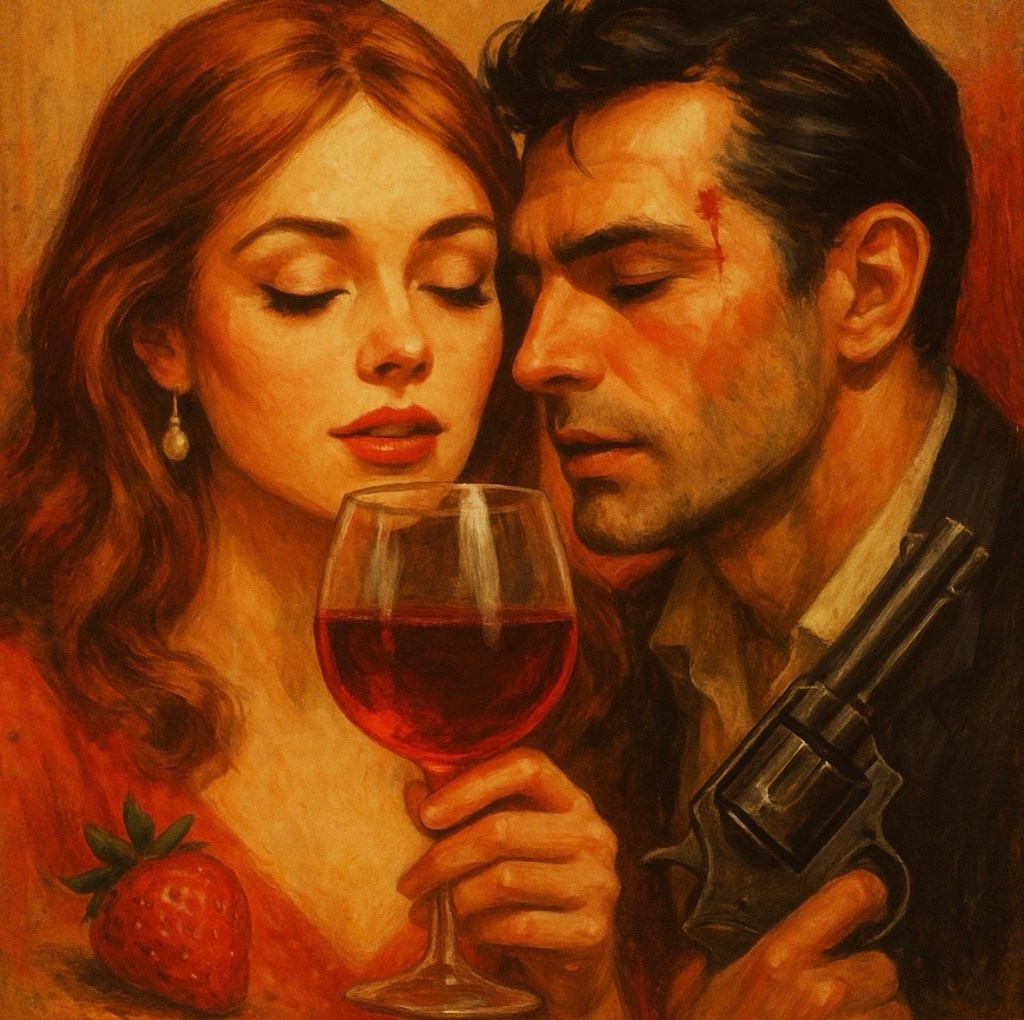
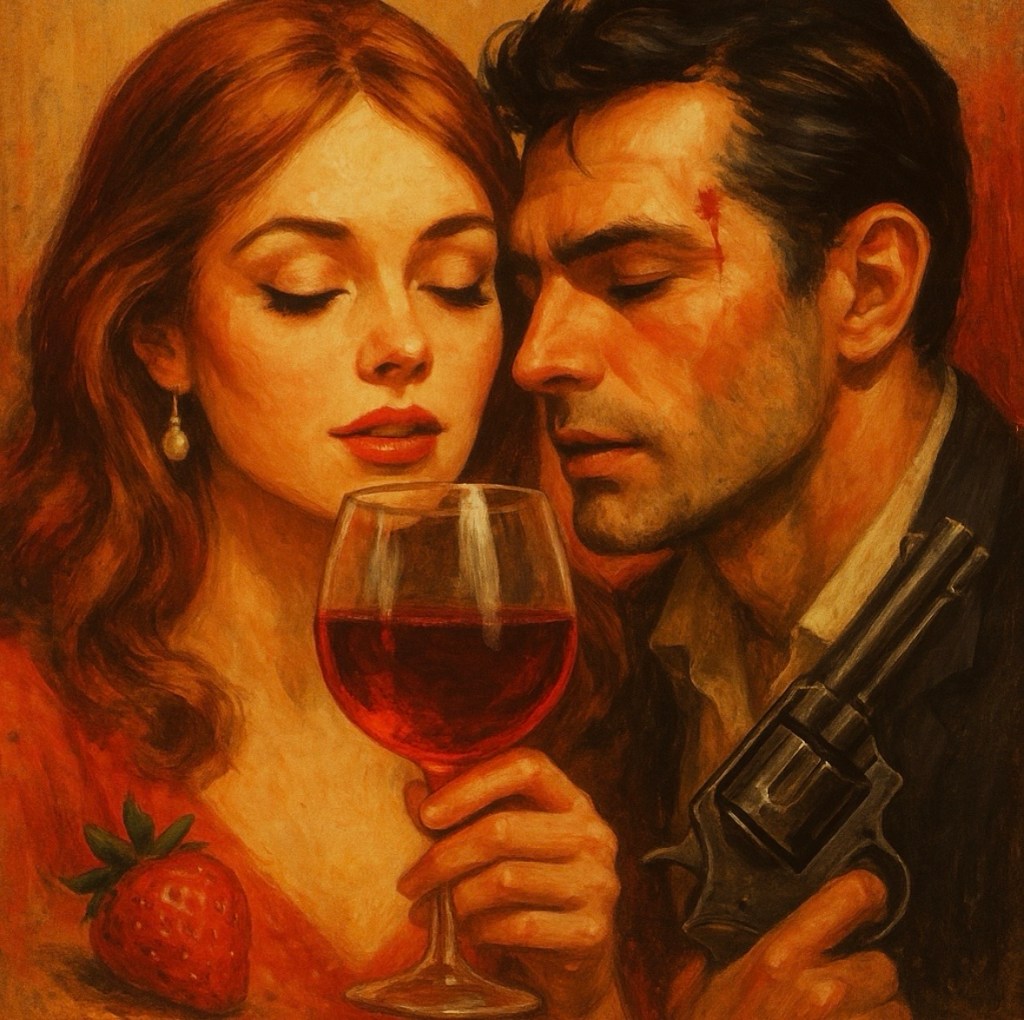
Seduzione e caduta, nello stesso gesto.
Seduction and collapse, in the same gesture.
Logica (intrapsichica) dei sentimenti, tra amore e violenza
Ci sono canzoni che raccontano una storia.
E poi ci sono canzoni che, con la scusa di una storia, raccontano come funziona la nostra psiche, la vita, gli incontri.
Summer Wine e Bang Bang sono questo.
Non sono solo due brani nostalgici, un po’ vintage, con una bella voce femminile sopra.
Sono un dittico.
Due pannelli della stessa tavola.
Il rovescio della medaglia che gioca a svelare i segreti dell’esperienza umana, con ritmo folk e voce ipnotica.
La stessa voce, lo stesso universo emotivo..
che però si spezza in due direzioni opposte.
Da una parte, la seduzione che stordisce.
Dall’altra, la ferita che ti lascia a terra.
Da una parte, Summer Wine.
Dall’altra, Bang Bang.
La stessa Donna, due volte.
Una volta come evento.
Una volta come trauma.
Summer Wine
Lui arriva in città con gli speroni d’argento che tintinnano, lo sguardo fermo.
È una caricatura di virilità western: un maschio da copertina polverosa, che non può cedere.
Cavalli di legno, andatura dinoccolata ma rigida, polvere, posa, un po’ di stanchezza.
Lei lo vede.
Non si presenta, non si dichiara, non si spiega.
Dice semplicemente:
«Vieni. Passiamo il tempo. Ti do del vino d’estate.»
Fragole, ciliegie, un bacio d’angelo in primavera.
Non è una ricetta: è una fiaba regressiva, ammaliante, innocente.
È l’infanzia travestita da cocktail.
È il latte materno sublimato in vino.
È l’adulto che torna, per una notte, all’onnipotenza di un amore che non chiede nulla in cambio.
Lui cosa fa?
Beve.
Beve fino a perdere la voce.
Beve fino a non sentire più i piedi.
Beve fino a crollare.
La (psico)analisi qui è semplice e spietata:
lui non vuole questa donna.
Vuole lo stato psichico che lei promette.
Vuole la regressione.
Vuole tornare pre-verbale, pre-edipico, pre-adulto, pre-responsabile.
Vuole smontare l’Io, almeno per una notte.
Rivuole la libertà assoluta dell’infante.
Lei è un oggetto, sì, ma non erotico in senso banale.
È un oggetto ibrido: drogante, accogliente, materno, seduttivo, magico.
Un oggetto materno-erotico che dice:
«Lascia. Ci penso io. Tu crolla. Smettila di tenere tutto insieme.»
E lui collassa.
Letteralmente: non sente più le gambe, non riesce a parlare.
La pozione, il Summer Wine, è il tramite, l’unica unione possibile.
Tra maschio e femmina, uomo e donna, non c’è incontro, ma incantesimo.
Lei “cura”, lui scompare.
Il sintomo è l’unione stessa: promessa, inganno, sortilegio.
È l’immagine perfetta della regressione soddisfatta.
Quando si sveglia, il mattino dopo,
gli speroni non ci sono più,
lei se n’è andata,
i soldi spariti.
È stato truffato?
Sì.
Ma il punto non è quello.
Il punto è che lui, dopo il furto,
dopo l’abbandono,
dopo la sbronza mistica,
dopo lo scippo travestito da favola erotica,
dice una sola cosa:
«Ne vorrei ancora.
Datemene ancora.»
Non vuole lei.
Vuole ancora Summer Wine.
La pozione magica, l’illusione dell’incontro e della libertà.
Questa è una delle dinamiche narcisistiche più diffuse:
usare l’Altro per accedere a un luogo della psiche
dove da soli non arriviamo,
e poi confondere l’Altro con quel luogo.
Lei lo sa.
E sorride, più disponibile, ammaliante e intoccabile che mai.
C’è un ghigno sornione, implicito, dietro quella voce dolce,
come se sussurrasse senza dirlo davvero:
«Non sei il primo, amore. Non sarai l’ultimo.»
Il potere adulatore della consapevolezza non ha rivali,
soprattutto quando è camuffato da disponibilità, resa, sogno, incantesimo.
Nessuna razionalità può difendersi.
Lei gioca con lo stereotipo della tentatrice,
lo usa con lucidità quasi professionale,
e lo rovescia.
Non è la “rovina del maschio ingenuo”.
È l’evento che svela quanto lui fosse già pronto a crollare.
Lui entra con gli speroni d’argento,
con l’illusione del controllo.
Lei gli offre un vino fatto di infanzia, frutti rossi, primavera,
e in una notte gli dimostra che tutta quell’armatura
era già un bluff.
Crede di essere “caduto per lei”.
Ma la verità è che non aspettava altro.
Che il guscio era la prigione.
Che il furto è stato, anche, una liberazione.
Perché l’incontro con il desiderio
non ammette deleghe
né ipocrisie.
Bang Bang
Potremmo fermarci qui.
Ma c’è un secondo pannello.
Stessa voce. Altro scenario.
Stessa donna, stessa voce ipnotica.
Qui non c’è vino,
non c’è fragola,
non c’è bacio d’angelo.
Ci sono cavalli di legno,
abiti bianchi e neri,
giochi d’infanzia.
La stessa innocenza ora si tinge di amarezza,
fino a diventare dolore, lacerazione, ossessione.
Bang bang.
“I was five and he was six…”
Lei in bianco.
Lui in nero.
Lei cade.
Lui vince. Sempre.
“He would always win the fight.”
Il gioco infantile è già un duello sbilanciato.
Lei ama.
Lui domina.
Passano gli anni.
Lei cresce, lo chiama “mio”.
Si sposano.
Le campane suonano solo per lei.
Ma il gioco non è mai finito.
Lui ride ancora.
Scherza sul passato:
«Ti ricordi quando giocavamo a spararci?»
Per lui è nostalgia.
Per lei è il codice segreto del rapporto:
lei a terra, lui in piedi.
E il colpo decisivo è qui:
«Bang bang, I shot you down…»
Lei lo dice:
anche lei sparava.
Anche lei faceva cadere lui.
Non è solo vittima.
È complice.
Ha partecipato a quella danza di potere,
cercando in quell’alternanza un riconoscimento
che non ha mai sentito davvero suo.
Poi il salto.
Un giorno lui se ne va.
“Now he’s gone, I don’t know why.”
Nessuna spiegazione.
Nessuna scena.
Nessun teatro.
E la frase più crudele:
«He didn’t even say goodbye,
he didn’t take the time to lie.»
Non ha nemmeno trovato il tempo di mentire.
Nemmeno una bugia pietosa.
Questo è il vero bang bang:
la sparizione senza teatro.
Il vuoto.
Solo vuoto.
Il ritornello torna.
E lei cade di nuovo.
Non è più la descrizione esterna di un fatto,
ma il meccanismo interno.
L’inciampo costante dell’interiorità che, per trattenere il senso,
continua a rimettere in scena la caduta.
Lui è sparito.
Lei resta con l’eco,
con la caduta automatica,
con il dispositivo che imprigiona la vita per preservarne il significato:
punisce per salvare,
colpevolizza per resistere,
inciampa per sopravvivere.
Contrappunto
C’è però un punto che sta oltre la storia,
oltre la seduzione,
oltre il trauma.
Un punto che nessuna delle due canzoni nomina,
ma che entrambe sfiorano.
Il cuore dell’umano non è né la regressione di Summer Wine,
né la ferita di Bang Bang.
È il movimento che li tiene insieme.
Oscilliamo.
Ricadiamo e ci rialziamo.
Siamo evento e siamo eco.
Offriamo un bicchiere che stordisce,
riceviamo un colpo che spezza.
Questa oscillazione non è un errore.
Non è una fragilità.
È la struttura stessa del desiderio.
È una danza.
Ed è da questa danza che, col tempo,
si formano delle posizioni.
Non identità né ruoli fissi,
ma posture affettive che impariamo ad abitare.
La posizione di chi stordisce
e quella di chi viene stordito.
La posizione di chi offre la pozione
e quella di chi la beve per non decidere.
La posizione di chi cade
e quella di chi impara, a volte troppo tardi,
a reggere la fuga dell’altro.
Perché l’amore non è ciò che consola,
né ciò che guarisce.
L’amore è ciò che ci espone.
E se una differenza esiste tra maturità e ripetizione,
è sottile ma decisiva:
non smettere di cadere,
ma smettere di chiamare “destino”
la caduta che scegliamo per non cambiare.
Summer Wine e Bang Bang dicono la stessa cosa, in due registri:
che ogni incontro è una trasformazione,
e ogni trasformazione ha un costo.
Che in ogni bicchiere offerto
c’è già un colpo futuro.
E in ogni colpo ricevuto
resta ancora un sapore dolce,
non perché fosse giusto,
ma perché ci ha toccati.
Bang bang.
E ci rialziamo.
Summer Wine.
E ci abbandoniamo di nuovo.
Finché c’è qualcuno davanti a cui possiamo cadere
senza subire l’urto,
qualcuno che possiamo ammaliare senza fuggire,
allora dell’amore resta questo:
non una fiaba,
ma un rischio che insiste,
che espone,
che rilancia la vita a se stessa,
che scioglie le posture,
non per girare a vuoto,
ma per fare del limite
una forma possibile di libertà.
Da ascoltare: Summer Wine e Bang Bang, nella voce di Nancy Sinatra.
ENG
The Faces of Love: Strawberries and Bullets
The (Intrapsychic) Logic of Feelings, Between Love and Violence
There are songs that tell a story.
And then there are songs that, under the pretext of a story, reveal how our psyche works,
how life works, how encounters take place.
Summer Wine and Bang Bang belong to this second kind.
They are not merely nostalgic, slightly vintage songs carried by a beautiful female voice.
They form a diptych.
Two panels of the same painting.
The reverse side of the same coin, playing at unveiling the secrets of human experience through folk rhythm and a hypnotic voice.
The same voice, the same emotional universe,
split, however, into two opposing directions.
On one side, seduction that intoxicates.
On the other, a wound that knocks you to the ground.
On one side, Summer Wine.
On the other, Bang Bang.
The same Woman, twice.
Once as an event.
Once as a trauma.
Summer Wine
He rides into town with silver spurs jangling, his gaze steady.
A caricature of Western virility: a dust-covered cover boy who cannot afford to yield.
Toy horses, a loose yet rigid gait, dust, posture, a hint of fatigue.
She sees him.
She does not introduce herself, does not declare herself, does not explain.
She simply says:
“Come. Let’s pass the time. I’ll give you summer wine.”
Strawberries, cherries, an angel’s kiss in spring.
Not a recipe, but a regressive fairy tale, bewitching, innocent.
Childhood disguised as a cocktail.
Mother’s milk sublimated into wine.
An adult returning, for one night, to the omnipotence of a love that asks nothing in return.
What does he do?
He drinks.
He drinks until he loses his voice.
He drinks until he can no longer feel his feet.
He drinks until he collapses.
The psychoanalytic reading here is simple and merciless:
he does not want this woman.
He wants the psychic state she promises.
He wants regression.
He wants to return to a pre-verbal, pre-Oedipal, pre-adult, pre-responsible state.
He wants to dismantle the ego, at least for one night.
He wants back the absolute freedom of the infant.
She is an object, yes, but not erotic in any banal sense.
She is a hybrid object: intoxicating, containing, maternal, seductive, magical.
A maternal-erotic object that says:
“Let go. I’ll take care of it. Collapse. Stop holding everything together.”
And he collapses.
Literally: his legs give way, his voice disappears.
The potion, the Summer Wine, is the medium, the only possible union.
Between man and woman there is no encounter, only enchantment.
She “cures,” he vanishes.
The symptom is the union itself: promise, deception, spell.
It is the perfect image of satisfied regression.
When he wakes the next morning,
the spurs are gone,
she is gone,
the money is gone.
Was he tricked?
Yes.
But that is not the point.
The point is that after the theft,
after the abandonment,
after the mystical drunkenness,
after the robbery disguised as an erotic fairy tale,
he says only one thing:
“I want more.
Give me more.”
He does not want her.
He wants Summer Wine again.
The magical potion, the illusion of encounter and freedom.
This is one of the most common narcissistic dynamics:
using the Other to access a place in the psyche
we cannot reach on our own,
and then confusing the Other with that place.
She knows it.
And she smiles, more available, more enchanting, more untouchable than ever.
There is a sly, implicit grin behind that sweet voice,
as if she were whispering without quite saying it:
“You’re not the first, love. You won’t be the last.”
The seductive power of awareness has no rival,
especially when disguised as availability, surrender, dream, enchantment.
No rational defense can withstand it.
She plays with the stereotype of the temptress,
uses it with almost professional lucidity,
and overturns it.
She is not the “ruin of the naïve male.”
She is the event that reveals how ready he already was to fall.
He enters with his silver spurs,
with the illusion of control.
She offers him a wine made of childhood, red fruit, springtime,
and in a single night shows him that all that armor
was already a bluff.
He believes he has “fallen for her.”
But the truth is he was waiting for nothing else.
That the shell was the prison.
That the theft was also a liberation.
Because an encounter with desire
admits no delegation
and no hypocrisy.
Bang Bang
We could stop here.
But there is a second panel.
Same voice. A different scene.
The same woman, the same hypnotic voice.
Here there is no wine,
no strawberries,
no angel’s kiss.
There are toy horses,
black and white clothes,
childhood games.
The same innocence now tinged with bitterness,
until it becomes pain, laceration, obsession.
Bang bang.
“I was five and he was six…”
She in white.
He in black.
She falls.
He wins. Always.
“He would always win the fight.”
The childhood game is already an unbalanced duel.
She loves.
He dominates.
Years pass.
She grows up, calls him “mine.”
They marry.
The bells ring only for her.
But the game has never ended.
He still laughs.
Jokes about the past:
“Do you remember when we used to shoot at each other?”
For him it is nostalgia.
For her it is the secret code of the relationship:
she on the ground, he standing.
And the decisive line is here:
“Bang bang, I shot you down…”
She says it herself:
she shot too.
She made him fall as well.
She is not only a victim.
She is complicit.
She took part in that dance of power,
seeking in that alternation a recognition
she never truly felt was hers.
Then the leap.
One day he leaves.
“Now he’s gone, I don’t know why.”
No explanation.
No scene.
No staging.
And the cruellest line of all:
“He didn’t even say goodbye,
he didn’t take the time to lie.”
He could not even find the time to lie.
Not even a merciful lie.
This is the true bang bang:
disappearance without theatre.
Emptiness.
Nothing but emptiness.
The refrain returns.
And she falls again.
It is no longer an external event,
but an internal mechanism.
The constant stumbling of the inner life which, in order to preserve meaning,
keeps replaying the fall.
He is gone.
She remains with the echo,
with the automatic collapse,
with the device that imprisons life in order to preserve its meaning:
it punishes to save,
it blames to endure,
it stumbles in order to survive.
Counterpoint
There is, however, a point beyond the story,
beyond seduction,
beyond trauma.
A point neither song ever names,
yet both of them brush against.
The core of the human is neither the regression of Summer Wine,
nor the wound of Bang Bang.
It is the movement that holds them together.
We oscillate.
We fall and we rise again.
We are event and we are echo.
We offer a drink that intoxicates,
and we receive a blow that breaks.
This oscillation is not a mistake.
Not a weakness.
It is the very structure of desire.
It is a dance.
And from this dance, over time,
positions take shape.
Not identities, not fixed roles,
but affective postures we learn to inhabit.
The position of the one who intoxicates
and the one who is intoxicated.
The position of the one who offers the potion
and the one who drinks it in order not to decide.
The position of the one who falls
and the one who learns,
sometimes too late,
to withstand the other’s flight.
Because love is not what consoles,
nor what heals.
Love is what exposes us.
And if there is a difference between maturity and repetition,
it is subtle but decisive:
not to stop falling,
but to stop calling “destiny”
the fall we choose in order not to change.
Summer Wine and Bang Bang say the same thing, in two registers:
that every encounter is a transformation,
and every transformation has a cost.
That in every drink offered
there is already a future blow.
And in every blow received
there remains a trace of sweetness,
not because it was right,
but because it touched us.
Bang bang.
And we get back up.
Summer Wine.
And we abandon ourselves again.
As long as there is someone before whom we can fall
without feeling the full impact,
someone we can enchant without fleeing,
then love leaves us this:
not a fairy tale,
but a risk that insists,
that exposes,
that throws life back to itself,
that loosens its postures,
not to spin in circles,
but to turn the limit
into a possible form of freedom.
Listen to: Summer Wine and Bang Bang, sung by Nancy Sinatra.
 Reverie Sonore
Lascia un commento