Te la do io la vita
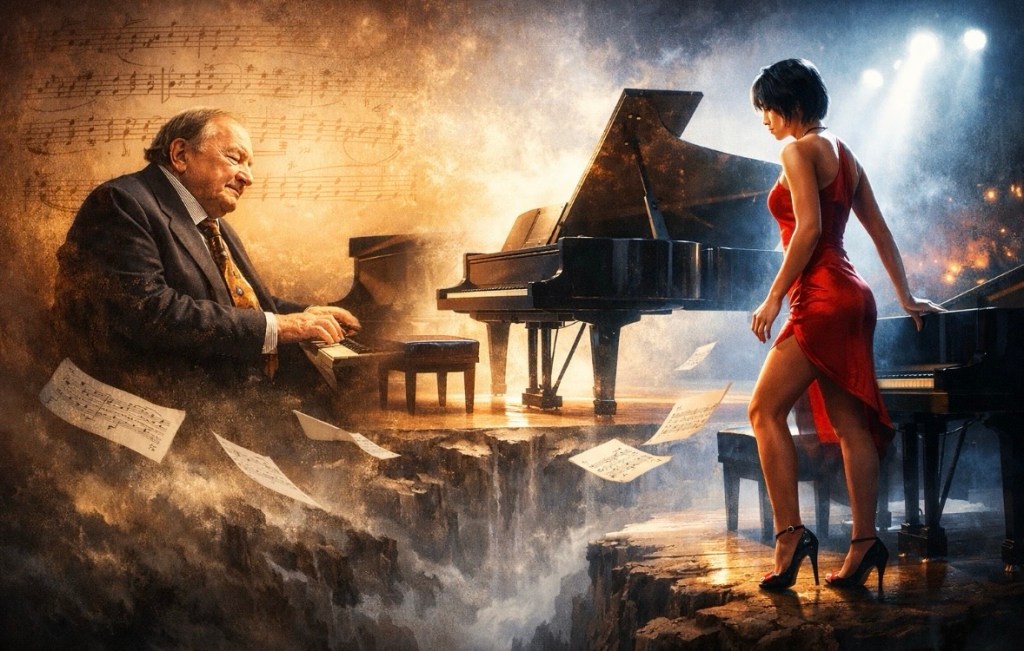
Due pianoforti sulla soglia, due modi opposti di abitare la vita nel suono.
Two pianos on the threshold, two opposite ways of inhabiting life through sound.
Quando Menahem Pressler siede al pianoforte, con la cravatta larga e ben annodata, quando socchiude appena gli occhi in uno stato di simil trance, quando attende un istante di più prima di iniziare il suo Chopin op. 20 a più di novant’anni, accade qualcosa di irreversibile.
Ti inchioda, educatamente. Non puoi più respirare né deglutire. Il suono viene sequestrato. La vita, dischiusa, comincia a vibrare.
La mente vaga, galleggia, cerca immagini, ma non ce ne sono. È tutto in quel suono, che sembra aver assorbito la densità del mondo e ora può restituirla solo in vibrazioni. Gli occhi restano socchiusi, l’espressione è fiera, le mani vibrano sui tasti quasi a imporre alle corde di non smettere di risuonare.
Si coglie subito che non può essere generosità né mestiere. È una dignità severa, così acuta e insieme così gentile, da riuscire a squadernare le norme e a incarnarle nello stesso tempo.
Sembra riuscire a comprimere la gioia di un giovane pianista che per la prima volta percepisce la vertigine della creazione dal di dentro, così come deve averla sognata Chopin, e insieme una saggezza millenaria. Il gesto del corpo non lavora più attraverso immagini, ma attraverso il gesto che diventa mondo.
I tasti non sono più cercati a vista. È un istinto, una grazia che sembra scorrere nel sangue stesso. Il pulsare è in leggero ritardo, sedimenta, respira, espande il suono oltre la vita.
Sentire il bambino e l’adulto, la saggezza e la gentilezza che lambiscono la vita e la disarmano, che la incoronano e insieme la scherzano, giubilando, è sconvolgente.
Per questo non riescono ad affiorare immagini. Non è una nostalgia terrena. Non è la mancanza della carne, dell’eros, della tenerezza. È la mancanza come contatto, la capacità di contenere oltre la contemplazione.
È come sedersi sul ciglio di un burrone e contemplare la bellezza del mondo, il suo respiro.
Consiglio d’ascolto
Chopin, Concerto per pianoforte n. 1 in mi minore op. 11, movimento lento, nell’interpretazione tarda di Menahem Pressler.
Non come concerto, ma come spazio di sospensione, dove il tempo smette di chiedere qualcosa.
Yuja Wang entra in scena molto prima di sedersi. Quella camminata lunga, che sembra brevissima e insieme infinita, in cui l’interrogativo martellante è incoercibile. Cosa indosserà.
Non è pruderie né eccitazione adolescenziale. È l’unica strada possibile, il non poter non cedere alla bellezza. Per questo la domanda non è solo centrale. È l’unica che conta. Non perché sia distante dalla performance musicale, ma perché ne è l’essenza.
Quando lei entra, la bellezza non è nel corpo tonico esibito né nel coraggio di contaminare il classicismo, ammuffito, con lo splendore scultoreo senza morigerarlo per ritegno. È nel gesto di volere tutto.
Il corpo non è altro dalla musica. È il centro. Lei lo sa. Per questo la sua Ballata n. 1 di Chopin inizia nel silenzio, quando, sopra vertiginosi tacchi, si avvicina a uno splendido pianoforte nero lucido, lucidato a specchio, con le corde che sembrano d’oro zecchino, su cui lo spettatore fantastica ogni volta che questa sarà la volta buona per distendersi.
Non è l’inizio di una suonata. È l’inizio di una guerra.
Quel rigore tecnico virtuosistico non serve a mostrare dominio, ma a spiazzare il corpo, destabilizzare la mente, accendere il fuoco della vita, della musica, dell’esserci. È la sfida di chi nasce con una fiducia nel mondo così piena da poter diventare provocazione.
In maniera indiretta ma inequivocabile ti sfida. Prova tu a rimanere indifferente alla vita.
Non c’è vera contemplazione. O accetti e vivi, o muori, perché la vita è solo lì, esposta, senza riserve.
Consiglio d’ascolto
Chopin, Ballata n. 1 in sol minore op. 23, nell’interpretazione di Yuja Wang.
Non come racconto romantico, ma come atto di presenza che non concede riparo.
Forse è per questo che non possono conciliarsi.
Non perché uno rappresenti il passato e l’altra il presente, o la tradizione contro la modernità. Ma perché mettono in scena due etiche della vita che non si sommano.
In Pressler la vita è qualcosa che si è lasciato passare attraverso, fino a diventare gesto, respiro, contenimento. Non chiede adesione, non provoca, non seduce. Sta. È una vita che non ha più bisogno di affermarsi, perché ha già accettato di perdersi.
In Yuja Wang, al contrario, la vita non è mai data. È continuamente reclamata. Non c’è distanza, non c’è attesa, non c’è contemplazione possibile. O entri, o resti fuori. O bruci, o scompari. Il corpo non contiene. Espone. Non raccoglie il mondo. Lo sfida.
Forse non si tratta di scegliere.
Forse queste due figure disegnano i limiti estremi entro cui l’esperienza umana può ancora dirsi viva. Da un lato la dignità che ha attraversato tutto, dall’altro la fiducia che non ha ancora rinunciato a nulla.
E in mezzo, il nostro ascolto, fragile, sospeso, chiamato ogni volta a decidere da che parte della vita si trova.
ENGLISH VERSION
I give you life
Chopin, border life
When Menahem Pressler sits at the piano, with his wide tie carefully knotted, when he slightly closes his eyes in a state close to trance, when he waits just a little longer before beginning his Chopin op. 20 at more than ninety years of age, something irreversible happens.
You are pinned down, politely. You can no longer breathe or swallow. Sound is seized. Life, opened, begins to vibrate.
The mind wanders, floats, searches for images, but none appear. Everything is contained in that sound, which seems to have absorbed the density of the world and can now return it only as vibration. His eyes remain half closed, his expression firm, his hands trembling on the keys as if forcing the strings not to stop resonating.
It is immediately clear that this cannot be generosity or craft. It is a severe dignity, so sharp and at the same time so gentle, capable of unfolding the rules and embodying them at once.
He seems to compress the joy of a young pianist experiencing for the first time the vertigo of creation from within, as Chopin himself must have dreamed it, together with an ancient wisdom. The body no longer works through images, but through a gesture that becomes world.
The keys are no longer sought by sight. It is instinct, a grace that seems to flow through the blood itself. The pulse lags slightly, settles, breathes, expands sound beyond life.
To feel the child and the adult together, wisdom and gentleness touching life and disarming it, crowning it and at the same time playing with it, rejoicing, is overwhelming.
For this reason no images emerge. It is not earthly nostalgia. It is not the absence of flesh, eros, tenderness. It is absence as contact, the capacity to contain beyond contemplation.
It is like sitting at the edge of a cliff and contemplating the beauty of the world, its breath.
Listening suggestion
Chopin, Piano Concerto no. 1 in E minor op. 11, slow movement, in Menahem Pressler’s late interpretation.
Listen not as a concerto, but as suspended time that no longer asks for anything.
Yuja Wang enters the stage long before sitting down. That long walk that seems at once very brief and endless, in which the hammering question is unavoidable. What will she be wearing.
It is not prudery nor adolescent excitement. It is the only possible path, the impossibility of not yielding to beauty. For this reason the question is not merely central. It is the only one that matters. Not because it is distant from musical performance, but because it is its essence.
When she appears, beauty is not in the displayed toned body nor in the courage to contaminate classicism, grown stale, with sculptural splendor without restraint. It lies in the gesture of wanting everything.
The body is not separate from music. It is its center. She knows this. That is why her Ballade no. 1 by Chopin begins in silence, as she approaches a shining black grand piano, polished like a mirror, its strings glowing like pure gold, upon which the listener always imagines that this time she might finally lie down.
This is not the beginning of a performance. It is the beginning of a war.
That virtuosic technical rigor does not aim to display mastery, but to unsettle the body, destabilize the mind, ignite the fire of life, of music, of being there. It is the challenge of one born with such trust in the world that it becomes provocation.
Indirectly yet unmistakably she challenges you. Try to remain indifferent to life.
There is no true contemplation. Either you accept and live, or you die, because life exists only there, exposed, without shelter.
Listening suggestion
Chopin, Ballade no. 1 in G minor op. 23, performed by Yuja Wang.
Listen not as romantic narration, but as an act of presence that allows no refuge.
Perhaps this is why they cannot be reconciled.
Not because one represents the past and the other the present, or tradition opposed to modernity. But because they stage two ethics of life that do not add up.
In Pressler, life is something that has been allowed to pass through, until it becomes gesture, breath, containment. It does not ask for adherence, does not provoke, does not seduce. It simply stands. It is a life that no longer needs to assert itself, because it has already accepted loss.
In Yuja Wang, on the contrary, life is never given. It is constantly claimed. There is no distance, no waiting, no possibility of contemplation. Either you enter or you remain outside. Either you burn or you vanish. The body does not contain. It exposes. It does not gather the world. It challenges it.
Perhaps it is not a matter of choosing.
Perhaps these two figures trace the extreme limits within which human experience can still be called alive. On one side the dignity that has passed through everything, on the other the trust that has not yet renounced anything.
And in between, our listening, fragile and suspended, called each time to decide on which side of life it stands.
 Reverie Sonore
Lascia un commento