ITA ENGLISH BELOW
La stanza della morte (e dell’amore)
Reverie e commento su: “La stanza del vescovo”.
regia Dino Risi
musiche Armando Trovajoli
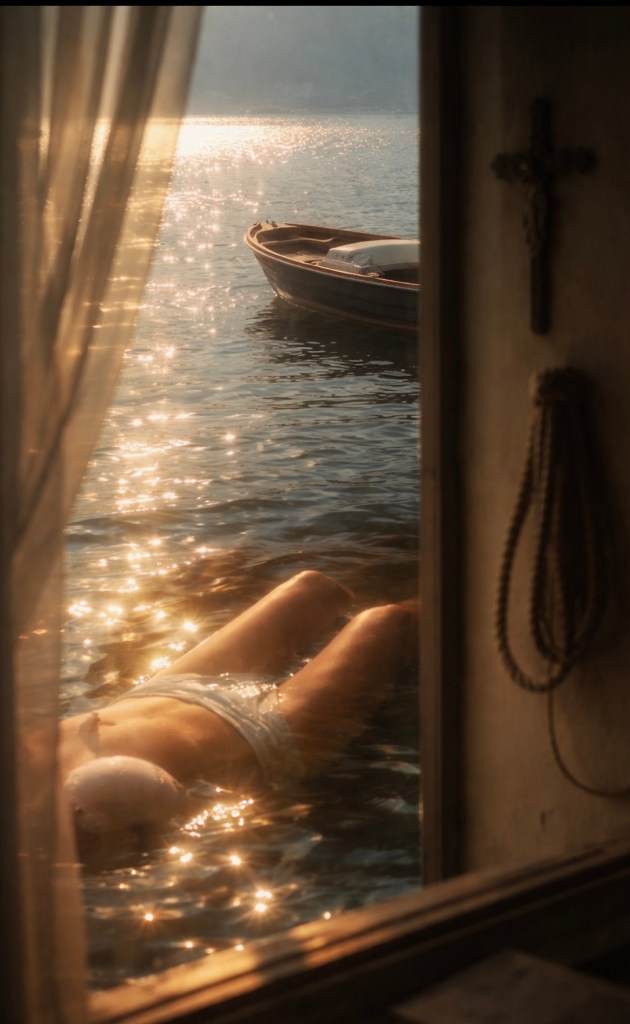
Il desiderio pulsa, riflette, commuove. Quando si chiude, diventa fine.
Desire pulses, reflects, moves us. When it closes, it turns into an ending.
La stanza del vescovo è un film in cui il desiderio, quello vero, non accade.
Non esplode, non si compie, non si lascia afferrare. Rimane di lato, deviato, riflesso a pelo d’acqua, come luce sulla superficie del lago. Forse tutto il film coincide con una sola scena. Orimbelli, con lo sguardo velato di lacrime, ammiccante e sfrontato, dice che a lui, a volte, la Tinca lo commuove. Lo dice mentre la macchina da presa indugia sui ventri nudi delle turiste, sul sesso femminile, sul centro caldo e muto dell’essere, tra il materno e l’apice dell’eccitazione. La frase, la posa e l’immagine coincidono moltiplicandosi caleidoscopicamente, frammentano la verità, la riducono a farsa. Lì il film si apre.
La Tinca è una barca, è un pesce, è una parola scivolosa. Ma in quel controcampo la commozione non riguarda né la barca né il lago. Riguarda solamente il corpo femminile, la vita nel suo pulsare, a prescindere. L’ironia è brutale e lucidissima, tra farsa, follia e morte. Orimbelli sta dicendo, senza dirlo, viva la figa. Non come slogan, ma come verità regressiva. L’unica cosa che lo commuove è ciò che non chiede parola, non chiede tempo, non chiede responsabilità. Il desiderio ridotto a immediatezza organica, l’affetto che scivola sull’organo, rimbalza, si perde, per non esistere mai come incontro.
In quello stesso lago in cui tutto avviene, l’acqua è azzurra, chiara, quasi innocente, pura, ma è anche densa, corrosiva, come un acido che lavora lento e non esonda, consumando la forma sociale e il buon gusto dal di dentro. La regia, pudica e spietata insieme, compie un’operazione chirurgica. Incornicia il desiderio nella commedia, lo rende tollerabile, sorridente, quasi amicale, e intanto lo incrina. Sotto affiora il giallo noir. Si incrina ancora e sotto appare il nero morale. Non c’è un cambio di genere. C’è una sovrapposizione. Come in certe vite. Si ride mentre si scivola, si sorride mentre si inciampa, finché, senza accorgersene, non si ride più.
Il primo grande colpo è il genio di Ugo Tognazzi. Una prova magistrale e a lungo fraintesa. Il suo esondare non è narcisismo d’attore. È ontologia. Un gigioneggiare messianico e miserabile insieme, dove vita, erotismo, squallore e morte convivono nello stesso gesto, si flettono insieme e respirano di verità e farsa simbiotiche. Orimbelli potrebbe restare un gaudente simpatico da commedia all’italiana. Invece Tognazzi lo spinge un centimetro oltre, quel tanto in cui la bonomia diventa viscida, pura poesia di viscidume. La caricatura non protegge più. Espone. Tra maschera e personaggio non c’è scarto. Colpendo Orimbelli, colpisce l’uomo. Tutto l’uomo.
Non sono le battute a fare male, ma i micro sfasamenti. La confidenza che arriva senza permesso, lo sguardo che indugia mezzo secondo di troppo, la risata che non libera ma copre. Il suo è un corpo che invade con violenza dimessa, che si posa sulle cose come se gli spettassero. Come chi si scusa per non aver fatto apposta e poi, sommessamente ma consapevolmente, insiste. Orimbelli non è solo vizioso. Usa il desiderio come tecnica di controllo, come usura silenziosa del confine. Il film è crudele perché lo lascia passare per normale, umano, per colore locale, finché, in pieno giorno, in giardino, arriva l’accusa che inchioda tutto. La viziosità persino con una ragazzetta, figlia di un ospite. Anche lì lui continua la recita. Elude, svuota le parole, si fa scudo del tono. Come se l’ironia fosse una legge che lo assolve. La realtà, accanto alla sua farsa, resta sempre due toni sotto. Già umiliata.
Con Marco, Orimbelli entra come entrerà con Matilde. Si appoggia. Compagnia, guida, protezione. Ma è un appoggio che pesa. Qui il contrasto è netto. Marco è errante, giovane, ancora capace di desiderare senza trasformare il desiderio in possesso, l’incontro in appartenenza. Orimbelli invece desidera come si firma una cambiale. Vuole che l’altro gli appartenga un poco, senza restituire nulla. Il valore dell’altro è sempre per sé. La complicità in barca, le turiste, l’erotismo che sembra gioco sono già un laboratorio. Tutto è permesso purché sia lui a gestirlo. La libertà, nel suo mondo, è ordine.
Il femminile entra come detonatore. Matilde non è solo bellezza. È un desiderio congelato. La villa, la casa, la stanza del vescovo non sono scenografie. Sono dispositivi di conservazione. Mantengono la donna intatta e insieme inutilizzabile. Per questo l’erotismo del film è scabroso anche quando è solo suggerito. Non perché mostri, ma perché vibra su una soglia tra vita e morte.
Matilde, in realtà, è l’unica che sente, malamente forse, ma sente, prima.
Sente che il desiderio di Orimbelli non è calore ma occupazione. Sente che quello di Marco è slancio senza tenuta. Sente che la casa, la villa, la stanza del vescovo non proteggono, imbalsamano. Ma questo sentire resta muto, corporeo, non ancora traducibile in atto, mai in sapere. Ornella Muti lavora tutta in questo frangente. In uno sguardo che sa già, in un corpo che avverte il pericolo prima che la coscienza lo formuli. È una donna che intuisce, ma non appartenendo al reale, non partecipando al mondo, non sa che può separarsi senza crollare. Ed è per questo che cede, a ciò che crede desiderio. Orimbelli prima, Marco dopo. Ma ancora, nulla accade veramente.
Quando Orimbelli intuisce l’interesse di Marco, non compete. Avvelena. Una confessione strategica basta a togliere all’altro il diritto di desiderare. È la logica del desiderio manipolatorio. Non conquista l’oggetto, elimina il rivale. Matilde, in questa fase, non è ancora soggetto. È territorio. E cede, non solo al corpo, ma alla struttura che le promette una forma.
Poi la svolta. Cleofe “annega” nella darsena, come l’antenato vescovo. L’acqua diventa inconscio che inghiotte ciò che la casa non contiene più. Il lago, da palcoscenico erotico, si fa prova. La domanda emerge, insopportabile. Quanta parte del desiderio è già crimine. Non giuridico, ma psichico. Quanta parte del desiderio è volontà di eliminare l’ostacolo. Vita e morte si tengono per la gola, separate da un confine sottilissimo che il desiderio finge di governare.
Il film sospende. La menzogna diventa pace provvisoria. Orimbelli e Matilde si sposano. L’eros si traveste da istituzione. Ed è qui che la normalizzazione rivela la verità. Non amore, appropriazione. Non incontro, recita. Finché il rimosso ritorna. Il marito di Matilde, vivo, evirato, reale. La Legge non come morale, ma come reale. Il castello crolla.
Ed eccola, allora, la stanza del vescovo. Non la stanza della colpa, ma la stanza del Super Io. Non quello che proibisce, ma quello che, come insegna Jacques Lacan, ordina di godere. Godi pure, purché resti dentro la cornice. Godi, purché non tocchi il reale. Orimbelli ha vissuto così. Ha trasformato il desiderio in diritto, in battuta, in abitudine. È il godimento perverso che Slavoj Žižek descrive come adesione perfetta all’ordine simbolico che ti dice puoi.
Ma il reale ritorna nel corpo ferito. La castrazione non come simbolo, ma come mancanza reale. Da quel momento la farsa non regge più. Per questo Orimbelli si uccide proprio lì. Non per espiare, ma perché la stanza che aveva usato come cornice nobile diventa la camera che chiude. Il Super Io non salva. Strangola. Un gesto coerente. Chi ha vissuto il desiderio come controllo non tollera il controllo della verità.
Matilde cambia statuto. Non più oggetto, non ancora promessa. Soggetto che emerge tardi, quando il prezzo è già stato pagato. La libertà, in quel mondo, non ha casa. Anche Marco se ne va. Nessun lieto fine. Solo una verità fredda. Il desiderio, quando è stato usato come strumento, non torna, non riconsegna alla vita.
Ecco perché La stanza del vescovo resta addosso.
Non è sexy. Non è giallo. Non è commedia.
È un film sul desiderio che, per esistere, si maschera, e mascherandosi diventa ambiguo, poi torbido, poi colpevole.
Tognazzi lo rende visibile mentre sembra ancora scherzare, quel centimetro oltre il copione, dove la risata non libera più e comincia a sporcare.
Forse non è il desiderio a fallire, ma il corpo stesso, quando smette di essere vita, quando smette di essere ciò che accade prima di ogni narrazione, ciò che precede la parola e smentisce ogni difesa. Come se Henry, situando nel corpo la soggettività e l’io, avesse sempre avuto ragione. Sulla psicoanalisi, sulla vita. E il film mostrasse che cosa accade quando il corpo non è più una verità abitabile. Per questo, con e contro Orimbelli: viva la Tinca!
Consiglio d’ascolto Reverie Sonore
Armando Trovajoli, La stanza del vescovo, tema principale.
A volume basso, come ciò che non vuole farsi notare. Proprio come il desiderio nel film.
Long live the Tinca. The Tinca that moves us.
ITA ENGLISH BELOW
The Room of Death and of Love
Reverie on The Bishop’s Room
directed by Dino Risi
music by Armando Trovajoli
The Bishop’s Room is a film in which desire, real desire, does not happen.
It does not erupt, it does not fulfil itself, it cannot be grasped. It remains sideways, deviated, reflected at the surface of the water, like light on the skin of the lake. Perhaps the entire film coincides with a single scene. Orimbelli, his eyes veiled with tears, flirtatious and brazen, says that sometimes the Tinca moves him. He says it while the camera lingers on the naked bellies of the tourists, on the female sex, on the warm and silent core of being, suspended between the maternal and the peak of excitation. The sentence, the pose and the image coincide by multiplying themselves kaleidoscopically, fragmenting truth and reducing it to farce. That is where the film opens.
The Tinca is a boat, it is a fish, it is a slippery word. Yet in that countershot the emotion has nothing to do with the boat or the lake. It concerns only the female body, life pulsing on its own, regardless of meaning. The irony is brutal and crystal clear, suspended between farce, madness and death. Orimbelli is saying, without saying it, long live pussy. Not as a slogan, but as a regressive truth. The only thing that moves him is what asks for no words, no time, no responsibility. Desire reduced to organic immediacy, affection sliding over the organ, bouncing, getting lost, never existing as an encounter.
In that same lake where everything happens, the water is blue, clear, almost innocent, pure, yet also dense and corrosive, like an acid working slowly without overflowing, consuming social form and good taste from within. The direction, modest and merciless at once, performs a surgical operation. It frames desire within comedy, makes it tolerable, smiling, almost friendly, and at the same time cracks it. Beneath it emerges noir. It cracks again and beneath appears moral darkness. There is no change of genre. There is superimposition. As in certain lives. One laughs while slipping, smiles while stumbling, until, without noticing, one no longer laughs.
The first great blow is the genius of Ugo Tognazzi. A performance both masterful and long misunderstood. His excess is not actorly narcissism. It is ontology. A messianic and miserable clowning at once, where life, eroticism, squalor and death coexist within the same gesture, bending together and breathing a symbiotic mixture of truth and farce. Orimbelli could have remained a likeable rake of Italian comedy. Instead Tognazzi pushes him one centimetre further, to the point where bonhomie becomes viscous, pure poetry of slime. Caricature no longer protects. It exposes. There is no gap between mask and character. By striking Orimbelli, he strikes man. All of man.
It is not the lines that wound, but the micro displacements. The familiarity that arrives without permission, the gaze lingering half a second too long, the laugh that does not liberate but covers. His body invades with subdued violence, settling on things as if they belonged to him. Like someone who apologises for not meaning to and then, softly yet knowingly, persists. Orimbelli is not merely lecherous. He uses desire as a technique of control, as a silent erosion of boundaries. The film is cruel because it lets him pass as normal, human, local colour, until, in broad daylight, in the garden, the accusation arrives that pins everything down. Lechery even with a young girl, the daughter of a guest. Even then he continues the performance. He evades, empties words, shields himself with tone, as if irony were a law that absolves him. Reality, beside his farce, always remains two tones lower, already humiliated.
With Marco, Orimbelli enters as he will later enter Matilde’s life. He leans in. Companionship, guidance, protection. But it is a weighty support. Here the contrast is sharp. Marco is errant, young, still capable of desiring without immediately turning desire into possession, encounter into belonging. Orimbelli instead desires as one signs a promissory note. He wants the other to belong to him a little, without giving anything back. The value of the other is always for himself. The complicity on the boat, the tourists, the eroticism that seems playful are already a laboratory. Everything is allowed provided he manages it. Freedom, in his world, is order.
The feminine enters as a detonator. Matilde is not only beauty. She is frozen desire. The villa, the house, the bishop’s room are not settings. They are devices of preservation. They keep the woman intact and at the same time unusable. That is why the film’s eroticism is disturbing even when merely suggested. Not because it shows, but because it vibrates on a threshold between life and death.
Matilde, in truth, is the only one who feels, perhaps clumsily, but feels, first.
She feels that Orimbelli’s desire is not warmth but occupation. She feels that Marco’s desire is momentum without endurance. She feels that the house, the villa, the bishop’s room do not protect, they embalm. Yet this sensing remains mute, bodily, not yet translatable into action, never into knowledge. Ornella Muti works entirely in this register. In a gaze that already knows, in a body that perceives danger before consciousness can formulate it. She is a woman who intuits, but because she does not belong to the real, does not participate in the world, she does not know that she can separate without collapsing. And that is why she yields, to what she believes to be desire. Orimbelli first, Marco later. Yet still, nothing truly happens.
When Orimbelli senses Marco’s interest, he does not compete. He poisons. A strategic confession is enough to strip the other of the right to desire. This is the logic of manipulative desire. It does not conquer the object, it eliminates the rival. Matilde, at this stage, is not yet a subject. She is territory. And she yields, not only to the body, but to the structure that promises her a form.
Then comes the turning point. Cleofe “drowns” in the dock, like the ancestral bishop. Water becomes the unconscious that swallows what the house can no longer contain. The lake, from erotic stage, becomes proof. The unbearable question emerges. How much of desire is already crime. Not juridical, but psychic. How much of desire is the will to eliminate the obstacle. Life and death grip each other by the throat, separated by a razor thin boundary that desire pretends to govern.
The film suspends. The lie becomes provisional peace. Orimbelli and Matilde marry. Eros disguises itself as institution. And here normalization reveals the truth. Not love, appropriation. Not encounter, performance. Until the repressed returns. Matilde’s husband, alive, castrated, real. Law not as morality, but as the real. The castle collapses.
And there it is, the bishop’s room. Not the room of guilt, but the room of the Superego. Not the one that forbids, but the one that, as Jacques Lacan teaches, commands enjoyment. Enjoy, as long as you remain within the frame. Enjoy, as long as you do not touch the real. Orimbelli has lived like this. He turned desire into right, into joke, into habit. This is the perverse enjoyment that Slavoj Žižek describes as perfect adherence to the symbolic order that tells you you may.
But the real returns in the wounded body. Castration not as symbol, but as real lack. From that moment the farce can no longer hold. That is why Orimbelli kills himself precisely there. Not to expiate, but because the room he had used as a noble frame becomes the chamber that closes. The Superego does not save. It strangles. A coherent gesture. One who has lived desire as control cannot tolerate the control of truth.
Matilde changes status. No longer object, not yet promise. A subject emerging late, when the price has already been paid. Freedom, in that world, has no home. Marco leaves as well. No happy ending. Only a cold truth. Desire, when it has been used as a tool, does not return, does not restore one to life.
That is why The Bishop’s Room stays with you.
It is not sexy. It is not noir. It is not comedy.
It is a film about desire that, in order to exist, masks itself, and in masking itself becomes ambiguous, then turbid, then culpable.
Tognazzi makes it visible while he still seems to joke, that centimetre beyond the script, where laughter no longer frees and begins to stain.
Listening suggestion Reverie Sonore
Armando Trovajoli, The Bishop’s Room, main theme.
At low volume, like what does not want to be noticed. Just like desire in the film.
Perhaps it is not desire that fails, but the body itself, when it ceases to be life, when it ceases to be what happens before every narrative, what precedes language and dismantles every defense. As if Henry, by situating subjectivity and the ego within the body, had always been right. About psychoanalysis, about life. And the film were showing what happens when the body is no longer an inhabitable truth. For this reason, with and against Orimbelli: long live the Tinca!
 Reverie Sonore
Lascia un commento