
Impressione d’ascolto – rêverie spontanea
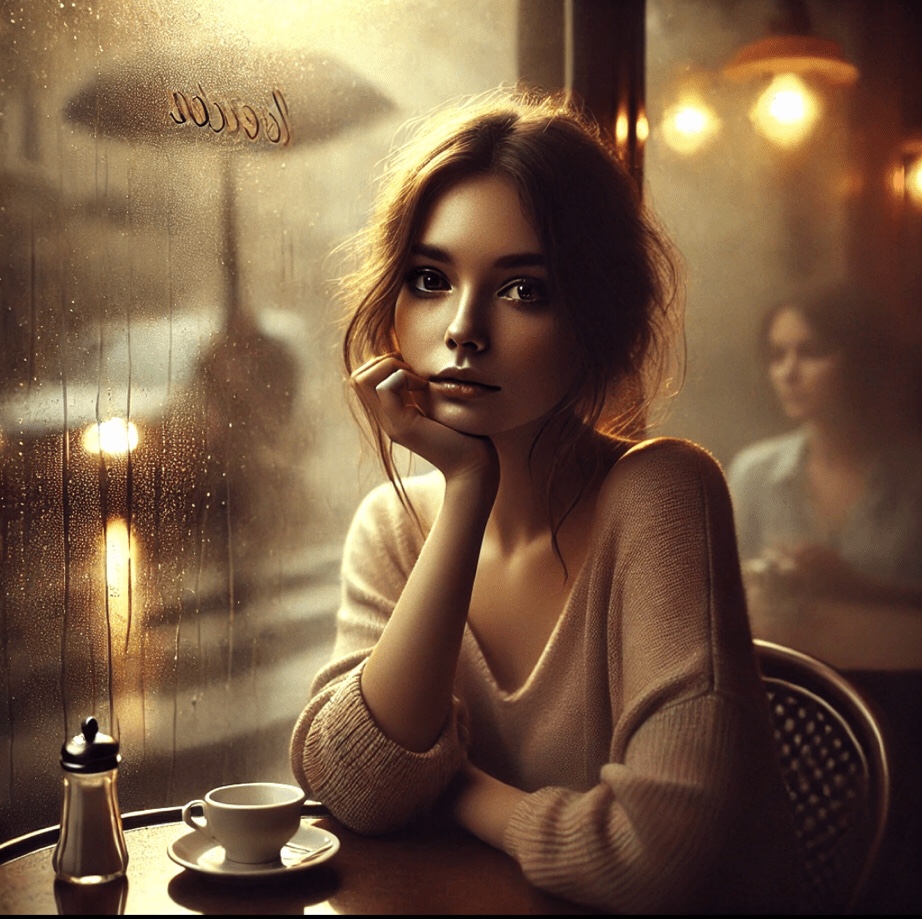
Lacrime accennate. Il vetro offuscato. Gocce di pioggia sul vetro.
Sei giovane, il locale è malconcio, il caffè che hai di fronte è freddo, lo sguardo imbronciato scruta un fuori che non si vede.
Il respiro è affannoso, gli occhi gonfi, ma la tua bellezza non può sfiorire né potrà essere più vivida di così. Non ora.
Ogni gesto sembra armonizzarsi con il respiro, con ogni goccia che scende.
Il cielo in terra? Possono i gesti essere infiniti? Si può parlare nel silenzio?
Guardami ancora.
È tutto sparito, cenni dal passato, invocazioni pressanti.
Ma tutto ti riporterà a me, senza fretta.
Il sorriso solo accennato. L’ultimo abbraccio.
Paura d’amare? Paura di morire di nuovo? Di sparire, di essere inghiottito? Il vuoto… dove sei?
Inerme. Nessun respiro. Singhiozzi trattenuti. Il sole verrà.
Gentili le tue premure, le tue carezze. Ogni tenerezza, ogni vulnerabilità condivisa.
Non cerco aiuto. Solo il calore.
Per guardare le stelle. Per correre nel verde. Per essere libero e spensierato.
Per essere uno con me.
Cerco la vita:
Presentati a me!
Riprendo il mio percorso. Riprendo il mio sguardo.
Cercherò altrove. Ma ogni scintillio di quest’attimo sarà con me.
La tua voce ancora. È qualcosa di mio. Anche ora che non ci sei.
Sento il mio esistere dilatato mentre pronunci nella mia mente il mio nome.
Le mani intrecciate nel silenzio.
Nella penombra non ho più timore.
Si scioglie ogni ritrosia. Ogni tensione.
Il pensiero si allenta. Il corpo non esiste più.
Sospensione esistenziale. Il mio è il respiro del mondo. Mi fermerò qui.
Il nostro essere affianco è la sola verità.
Non dubitare dei miei errori: non li userò contro di te.
Ogni protezione sarà cura dell’avvenire.
Fili sottili d’erba, lunghi i tuoi capelli ricci: profumavi l’aria e anche il sole sembrava arcobaleno.
Non posso fare a meno di te. Nemmeno se smettessi di esistere.
Il mio cammino appare desolato, vigliacco, disgraziato.
Eppure il re non è mai esistito.
Il mio padrone aveva il mio volto.
Non posso tremare di fronte a ciò che è reale.
Combatterò con lealtà.
Le mie ferite mi cureranno.
Le paure si quieteranno.
Ora lasciatemi così, ancora,
come una cosa posata in un angolo e dimenticata.
Me ne starò col caldo buono del focolare.*
Nessun tradimento. Nessuna fuga.
Sarò sempre io per te.
Lo vorrai?
Attendiamo insieme ogni avvenire.
Il sorriso dei sogni tratteggerà il nostro cammino.
*Questa rêverie ha richiamato un passo della poesia “Natale” di Giuseppe Ungaretti, che l’autore aveva imparato a scuola in terza elementare.
La forma dell’intimità che resta
Note psichiche a margine della Pavane
Ci sono brani che sembrano non evolvere, non spiegarsi, non concludersi.
Restano lì. Si muovono senza procedere. Non trasformano: accarezzano.
La Pavane, nella sua essenza, non racconta una storia. È una forma. Una disposizione d’animo. Un pensiero in sospensione.
In questa rêverie, la musica non accompagna un ricordo: è il ricordo.
Non quello preciso, databile, ma la sua presenza fantomatica: un volto dietro il vetro, una voce nella mente, una tenerezza che non si è mai dissolta davvero.
La Pavane non è nostalgia, ma persistenza. Un sentimento che resta senza invadere, che vive in una zona affettiva dove non serve più decidere se appartiene al passato o al presente. È un transfert senza oggetto.
Ciò che accade, psichicamente, è un ritorno silenzioso a ciò che ci ha toccati senza trafiggerci, rivelandoci la sostanza del nostro volto.
Non il trauma, ma l’intimità fragile.
Non l’abbandono, ma la delicatezza della presenza mancata.
Una scena interna in cui l’altro è ancora lì, nonostante tutto: “il sorriso solo accennato”, “l’ultimo abbraccio”.
Non si tratta di un’immagine idealizzata, né di una difesa dall’angoscia:
è piuttosto la memoria di un legame che oltrepassa le separazioni, che attraversa l’identità senza per questo farsi fusionale.
È il dono del rispecchiarsi riconoscendosi e, al tempo stesso, ampliando in quell’istante il proprio saper essere.
Un gesto d’amore simmetrico tra sé e l’altro.
In certi momenti, nella stanza d’analisi, qualcosa di simile può emergere.
Non un racconto lineare, non un sintomo rumoroso. Ma un’atmosfera. Un’eco.
Una zona relazionale in cui l’altro si fa presente non come figura definita, ma come possibilità di tenerezza.
E lì, nella sospensione, può accadere qualcosa di straordinario: la cura si fa spazio condiviso, e lo spazio indizio di intenzione alla liberazione.
Come nella Pavane, ogni frase musicale sembra dire “ci sono”, senza pretendere nulla di definito o definitivo.
Il tempo, nella Pavane, non spinge in avanti.
È un tempo intrapsichico, fatto di attese non drammatiche, di passaggi interni che non hanno fretta né tensione.
È la temporalità dell’elaborazione profonda, quella che avviene quando “l’inconscio” non ha più bisogno di difendersi, ma solo di continuare a esistere.
Anche la rêverie che accompagna questo brano è fatta di movimenti lenti, di memorie che affiorano senza chiedere di essere risolte.
Si tocca qui una dimensione spesso trascurata nel viversi, così presa dalla dinamica degli eventi, dal fare, o, nella stanza d’analisi, dalla trasformazione e dall’insight: la potenza clinica della permanenza silenziosa, del non orientare, del restare insieme in ciò che è già stato e viene vissuto.
C’è una cura dello stare insieme.
Ci sono amori che non hanno bisogno di attualizzarsi.
C’è un transfert che non cerca elaborazione subitanea, ma solo ascolto.
Come nella Pavane, si resta in quel respiro.
E si scopre che non c’è bisogno di andare oltre: l’amore può esistere anche senza progetto, anche senza conflitto, anche senza parola.
Questa è forse la forma più sottile dell’intimità psichica:
non l’urgenza di dire, ma la possibilità di restare.
Pavane, Ravel – The Shape of Intimacy That Remains EN
Listening impression – spontaneous rêverie
Hesitant tears. The fogged glass. Raindrops on the window.
You are young, the place is run-down, the coffee before you is cold, your sullen gaze scans an outside that cannot be seen.
Your breath is labored, your eyes are swollen, but your beauty cannot fade, nor could it ever be more vivid than now.
Every gesture seems to harmonize with breath, with every drop that falls.
Heaven on earth? Can gestures be infinite? Can one speak in silence?
Look at me again.
Everything has vanished, fragments from the past, pressing invocations.
But everything will lead you back to me, slowly.
The faint smile. The last embrace.
Afraid to love? Afraid to die again? To disappear, to be swallowed? The void… where are you?
Helpless. No breath. Stifled sobs. The sun will come.
Your attentions are gentle, your caresses. Every tenderness, every shared vulnerability.
I don’t seek help. Only warmth.
To gaze at the stars. To run in the green. To be free and carefree.
To be one with myself.
I seek life:
Present yourself to me!
I resume my path. I reclaim my gaze.
I will search elsewhere. But every glimmer of this moment will stay with me.
Your voice still. It feels like something of mine. Even now that you’re gone.
I feel my existence expanding as you pronounce my name in my mind.
Hands intertwined in silence.
In the dimness, I no longer feel fear.
Every hesitation dissolves. Every tension.
Thought loosens. The body ceases to exist.
Existential suspension. My breath is the breath of the world. I will stop here.
Our being side by side is the only truth.
Don’t doubt my mistakes: I won’t use them against you.
Every protection will be care for what’s to come.
Blades of grass, your long curly hair: you scented the air, and even the sun seemed like a rainbow.
I can’t do without you. Not even if you ceased to exist.
My path appears desolate, cowardly, disgraced.
And yet the king never existed.
My master bore my face.
I cannot tremble before what is real.
I will fight with loyalty.
My wounds will heal me.
Fears will soften.
Now leave me like this, still,
like something placed in a corner and forgotten.
I will remain with the warm comfort of the hearth.*
No betrayal. No escape.
I will always be myself for you.
Will you want that?
Let us wait together for whatever future comes.
The smile of dreams will outline our path.
*This rêverie recalled a passage from the poem “Natale” by Giuseppe Ungaretti, which the author had learned in elementary school.
The shape of intimacy that remains
Psychic notes on the margins of the Pavane
There are pieces that seem not to evolve, not to explain themselves, not to conclude.
They remain. They move without proceeding. They do not transform: they caress.
The Pavane, in its essence, doesn’t tell a story. It is a form. A state of soul. A thought in suspension.
In this rêverie, music does not accompany a memory: it is the memory.
Not the precise, datable one, but its phantom presence: a face behind glass, a voice in the mind, a tenderness that never truly dissolved.
The Pavane is not nostalgia, but persistence. A feeling that remains without invading, that lives in an affective zone where there is no longer any need to decide whether it belongs to the past or the present. It is a transference without object.
What happens, psychically, is a silent return to what touched us without piercing us, revealing the substance of our own face.
Not trauma, but fragile intimacy.
Not abandonment, but the delicacy of a missing presence.
An inner scene in which the other is still there, despite everything: “the faint smile,” “the last embrace.”
This is not an idealized image, nor a defense against anguish:
it is rather the memory of a bond that surpasses separations, that crosses identity without becoming fusion.
It is the gift of mirroring each other with recognition, and at the same time, expanding one’s own being-in-the-world in that instant.
A symmetrical gesture of love between self and other.
At certain moments, in the analytic setting, something similar can emerge.
Not a linear narrative, not a noisy symptom. But an atmosphere. An echo.
A relational zone in which the other becomes present not as a defined figure, but as a possibility of tenderness.
And there, in suspension, something extraordinary can occur: care becomes shared space, and space becomes a sign of an intention toward liberation.
Like in the Pavane, every musical phrase seems to say “I am here,” without demanding anything defined or definitive.
Time, in the Pavane, does not push forward.
It is an intrapsychic time, made of non-dramatic waits, of internal passages with no rush or tension.
It is the temporality of deep elaboration, the kind that arises when the unconscious no longer needs to defend itself, but simply to continue existing.
The rêverie that accompanies this piece is also made of slow movements, of memories that surface without asking to be resolved.
Here we touch a dimension often neglected in our living, so absorbed by the dynamics of events, by doing, or, in the analytic room, by transformation and insight:
the clinical power of silent permanence, of non-orientation, of staying together in what has already been and is still being lived.
There is a kind of care in simply staying.
There are forms of love that do not need to be actualized.
There is a transference that does not seek immediate elaboration, but only listening.
As in the Pavane, one remains in that breath.
And one discovers there is no need to go beyond: love can exist even without a project, without conflict, without words.
This may be the most subtle form of psychic intimacy:
not the urgency to speak, but the possibility to remain.
 Reverie Sonore
Lascia un commento